Showing posts with label Scenework. Show all posts

Saturday, 2 September 2017

Ten lessons for improvisers from the movie Alien

Alien (1979, dir: Ridley Scott) is a great example of a science fiction movie. You may have seen it. Frankly you should have seen it. I don’t think you need to have to follow this post, but why resist seeing it, you’re only depriving yourself.

Improvising in science fiction is fraught with danger. These dangers are the same that film-makers also face. So looking at a successful science fiction movie can give us some insight into how to do it well. The same goes for horror, which is relevant, as we will see. Let’s look at Alien and find ten lessons about improvised genres and improvised narratives.

People still eat, no matter what era it is.
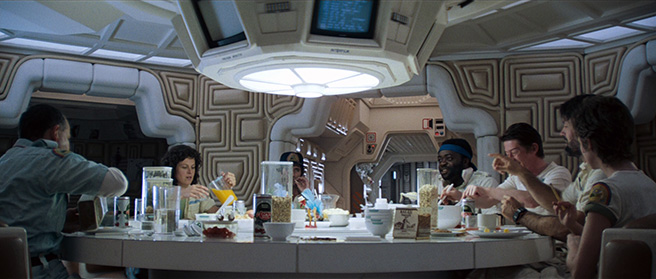
  1. People have always been, and always will be, people. People in science fiction don’t have to be weird, unrelatable aliens. In fact they rarely are. The crew of the Nostromo are blue-collar workers doing a hard job. They are the crew of a towing vessel. Today they would be the crew of a freighter. They are all people we could and relate to in our ordinary non-future lives. 
  2. Establishing character through dialogue. Our main introduction to the crew is through a conversation over a meal. Here they chat, joke, argue and generally show their outlook on life through how they talk and what they say. Again, it should be noted, they are not talking about weird space stuff, they are talking about getting paid and what their job entails, and the sorts of things we talk about when we’re at work. People will not be radically different in a few hundred years time.
  3. Science Fiction often has another genre. Although most people would say the genre of the movie Alien is science fiction, the story is pure horror. Science fiction is almost always a filter put over the top of another genre. At least, that’s how I like to view it. Science fiction is actually very broad as a genre, and in a way gives us very little concrete to start with, and plot-wise gives us even less. A science fiction story can be set in any time or place, both real and imaginary. It doesn’t have to be set anywhere near space. However, if a story is set in space, it is automatically science fiction. (At least it will be until space travel is boringly routine for us as a species.) Alien goes for what could be called a classic setting for science fiction, a space ship. But it is not an exploration ship on a voyage to explore new planets; it’s not a battle cruiser off to battle against the interplanetary federation; no it’s basically a tug taking a cargo of something mundane back to Earth.

  4. Relationships. It’s important to establish the relationships of the main characters early on in a story. A lesson here is that, most relationships are not going into in much depth. This is not a relationship-driven story and in fact not so much time is spent on it, but you do get to learn some of the connections that people have to each other – it’s mostly who gets on with whom and who doesn’t get on so well together. This is partly because there are 7 characters at the start and so we can’t keep track of 21 relationships. (The equation is n(n-1)/2, if you were wondering.) It’s also because horror is not (usually) a relationship-driven genre. The action is not dictated as much by the actions of the main characters as it is by some outside entity. Plus most of the people you meet at the beginning ain’t going to make it. In horror, as a rule, we don’t follow and identify with the main characters because we are fully invested in their character but because we empathise with their predicament and don’t want them to be brutally murdered.
  5. Alien is not about the alien, but about the crew’s attempts to avoid getting killed by the alien.
  6. Baby killer aliens can be cute too.
  7. Gore or lack of it. Although we see some of it, we don’t actually see too much of the alien killing the victims. Horror (aside from the gore and slasher subgenres) is much more about the build-up of suspense and the reactions than the actual horrific acts. Which is good for improvisers as it’s hard to mime a good decapitation. Especially one that isn’t funny. But atmosphere and reaction we can do. However, the trick is that atmosphere and reaction require total commitment to it. Which sounds like the realm of improv, but, in improv the commitment is often only to the funny, and applied far less to the dramatic or real side of things. But with commitment (and good music) a scary atmosphere can be achieved pretty easily. One good tip is your character should genuinely be scared. At no point in the movie do you think, “that actor is just playing scared.” You certainly don’t see what you too often see on an improv stage, a character playing some sort of vaudevillian, knowing spoof of a scared person. You see the fear of the characters. That’s the only way horror works.
  8. Establish the rules of the world. Some sci fis have wildly different rules to the world we know, but most don’t. The one’s we relate to most do not have that much which makes it alien to what we know. There should probably be some new rules, as this is an important part of sci fi, but there do not have to be many. And the characters are usually used to the rules of this world, and so live them, understand them and are not surprised by them. Rules can be small or large. Things that are different have to be explained or demonstrated. In Alien it is explained that they have to respond to the SOS beacon because that’s one of the rules AND that their pay depends on it. Also, the rules of the autodestruct system (in particular that there is a time-limit to the over-ride function, which only makes sense plot-wise) are explained by the autodestruct’s own voiceover. Also in Alien it is enough to show that steam coming out of vents at various points of the ship is a regular thing for us to accept it is an important part of the workings of the ship, even if part of us doesn’t get why, once we see it a couple of times, we accept it as something that happens in the world of that ship.
  9. Technology changes the way we do some things but we are still humans. We won’t spend all of our time talking about technology (okay, some of us will, but most of us won’t), but we will use that technology in our everyday lives. This is easier to do in a movie where we can show so much without having to talk about it, but even in stage-bound improvisation, we can have scenes where we have a lot of new technology around us, but we just use it rather than talk about it or over explain it. Note this last thing is not just a trap for improvisation, but a lot of terrible sci fi does it too. The trick is to talk about what’s going on with the characters and not about the tools you are using.
  10. Androids and robots are only really interesting when they have or want human emotions. The biomechanical android is so convincing as a human, it only becomes clear it’s an android when it’s head gets knocked off. And although looking back, the seemingly emotional choices of the android had a less emotional driver, it does reveal some emotions we can (sort of) relate to in that it has the capacity to admire. Although it admires the alien for being “unclouded by conscience, remorse, or delusions of morality.”
  11. In horror (certainly since the seventies), just when you think it’s over, it isn’t.

  12. Attitude.

    Any other lessons you’ve seen from this movie? Any alternative takes you have? That’s what the comments are for.

Wednesday, 25 January 2017

IMPRO Amsterdam 2017: Day 1: The Mondayening (part 1)

The performing part of the public festival started off with an open stage, where eager festival attendees can perform with each other and cast members. Unfortunately due to a scheduling conflict no cast members could be there, but 20+ eager improvisers of all levels from all corners of the globe did turn up. I made them play all those classic games you do when you start plus a couple of slightly harder ones which they all did with that spirit of fun that infuses much of improv.

Journey to the centre of the Earth.

You don’t really expect the first day of the festival to knock the ball out of the park, but there were a couple of moments where the ball got send way beyond the edge of the theatre and a metaphorical ballboy had to run off and get it.

The smoker takes it all... Gbgimpro sing "Smoking!" from the unmade musical "Smoking!"
Picnic Impro leave us speechless

In the first half, Each team got to show off what they do, that is what they will do in later shows. Well, kind of. The Swedes sang an amazing, stunningly-accurate high school musical song about smoking; the Dutch team (who actually don’t have their own show, but mix in with others) explored relationships at a typical Dutch celebration; the Portuguese performed a highly dramatic scene and then sang beautifully about it (in a classic Portuguese fado style); the Colombians told the story of 2 wrestlers coming together for a fight with no words, only phenomenal mime, clowning and acrobatics, aided by a sountrack. If I had to pick a highlight this would be it. Every now and again you see a set off skills on stage and you go to yourself, “I so wish I could do that.” This was such a moment for me.

Paul Dome reaches another
high point in his improv career
Team America are Big Bang (from Boston) who take the kinetic impulse and energy from the beginning of the universe and transfer it onto stage. They not only showcased their impressive brand of quick-fire, quick-change, energetic improv, but the also they threw in a rule whereby one of their players (Paul Dome) was not allowed to touch the floor for the entire set. What transpired was a hugely playful workout, not just for the other 2 players but also the audience who had to carry Paul all the way to the back of the room and back (to the front that is). In terms of committing whilst having fun with each other, they are a group hard to beat.

Because only half of the British duo was there, which is (2 multiplied by 1 over 2, carry the 1, round to the nearest decimal…) just 1; and Patti Stiles was there not with a team but with just herself (that's 1 minus 0 divided by 0, no that means there were an infinite number of Pattis); plus the Colombians had brought a Canadian to provide their soundtrack… these appeared together as The Commonwealth, which is the euphemistic title the British have for the collection of countries it obtained to enrich itself.

Patti and Charlotte get in deep.

Charlotte (UK) and Patti (CA/AU) played a scene inspired by music from Sarah Michaelson (aka DJ Mama Cutsworth, CA). This scene about a woman and her grown-up imaginary friend had that kind of genuine depth of exploration of what it is to be human you rarely find in an improv scene. Hell,you don't get it in movies enough. Again the poor ballboy had to run and fetch the ball.

Tuesday, 24 January 2017

IMPRO Amsterdam 2017: Sneak Preview

Every year just before the start of the IMPRO Amsterdam festival proper, there is a sneak preview show where the teams playing at the festival perform for the organisers, volunteers and other members of the organisation behind the festival, TVA.

For those of you who don’t know, TVA is a sort improv academy / social club providing classes for all levels (from beginners to yellow (yes, the levels go all the way to yellow)). It started the festival long ago before many of you (us?) even knew what improv was (before some of you could even string the words “yes” and “and” together, I'll bet), so that they can invite groups from around the world they wanted to see and learn from. The founding principles still remain, but after 20-odd years the festival has grown and become as close to a well-oiled machine as any festival can be.


The sneak preview is a chance for the cast to warm up before the week and also to thank all those people who helped make the festival happen. We were treated with two sets of musical-inspired montages. A montage in this context is a sequence of seemingly unrelated scenes (which I might make the title of my first movie). Obviously nothing in life is unrelated - we are all connected by his hallowed noodly appendages - and an audience will find the hidden connections. What I enjoyed most about the show was seeing great players giving themselves the time and space to build great scenes. Players who yesterday were not a team. In fact many had not met before that day.


The scenes that emerged were sometimes amazing. There were a couple that turned out to be super dramatic: something that does not happen in improv so much at all, but shows how it’s not simply a medium for comedy but a method to create any form or style. Most notable was the tear-jerkingly realistic goodbye scene between Patti Stiles and Paul Dome.


What was also great about the show was already getting a chance to see some of the differences in styles that players from different backgrounds and places bring. There is a nice mix of players and they already feel like a team. It bodes well for the rest of the fest.


Last night’s interviews (for which you might read “conversations I drunkenly stumbled into”) included a promise that Patti Stiles, Charlotte Gittins and myself made to solve all of the world's problems - more on this later in the week; and having Will Luera explain how improv is basically physics. There is too much information to go into in one simple blog - you’ll have to take his workshop on the subject or read Stephen Hawking’s "A Brief History of Improv."


Saturday, 28 March 2015

5 James Bond Villains and 2 Henchmen You’ll Meet in Improv


The murky yet glossy world of James Bond might seem a long way from the world of improvised comedy, but is it really? There is a lot of making the rules up as you go along, taking big risks, and using what you have there and then to make the best situation. And just occasionally someone has a dastardly plot to take over the scene. So here are a few of the Bond villains and henchmen you’ll meet at improv workshops and shows.

Auric Goldfinger

Goldfinger is obsessed with gold. Every scene will have something about gold in it. Everything he has is made of gold. People he doesn’t like will be killed using gold. You might think he’ll get bored with all that gold, but nope.

Ernst Stavro Blofeld

It’s always good being physical, and a great way to avoid being static is to have something to do to avoid just standing there with your arms by your side or in your pockets. Blofeld has a built-in go-to activity. In the quiet scenes, which is all of them except when he’s running around in a panic, he will be stroking his imaginary cat.

Dr No

Dr No will block any effort in your mission to have a great scene. He’ll block you no matter what you try. And he’ll get clever at it (he’s a Dr after all) so that you are not even aware he’s blocking you, but somehow the scene goes nowhere.

Francisco Scaramanga

If you have a magical weapon, surely you should use it whenever possible. There’s no point in using some other form of fighting when you have a golden gun. This villain has a device he’s very pleased with. He’ll use it to solve every situation he possibly can. The effect is often fatal.


Gustav Graves

Oozing with self-assurance and ready to snipe at any person he thinks he’s better than, which is everybody else. He’s got the swagger of someone who is damn sure of himself, but you somehow suspect he’s a very different person under that bravado.

Pussy Galore

What every scene needs is some good old sexual innuendo or just plain, outright sexual references. No matter what this scene is, where it’s set, what the relationship is, it will always lead to something sexual.

Oddjob

Oddjob doesn’t say much. But you tell him to do something, he’ll lumber off with hunched, tense shoulders, do it and then lumber back and wait your next offer in silence.

There are lots more villains and henchmen. Which ones have I missed that you have seen?

Thursday, 10 July 2014

Game of Crows

Right at the start of a scene it's good to establish some key facts that give us a foundation to build from. There are various alliterations and mnemonics to help you remember this, such as "who, what, where" and "CROW" (namely, "character, relationship, objective and where"). These are good reminders of what a scene should have early on, sometimes from the get-go and sometimes they are discovered, but either way it's very, very helpful to have the relationship, location and some sort of activity established before we get into the meat of the scene.

It's an area people have a lot of difficulty with because on the one hand we are often trying to be naturalistic or at least not "clunky" and on the other hand we need that information out there both as players and as an audience. In real life we might greet our colleagues in the office with a friendly grunt, but in improv it's more likely to be something more like "Good morning, Brad. I love working in this match factory with you where we've worked for 5 years." Clunky, right? But all good information.

I'm not saying that it can only be clunky. I think we should practice so that this information comes out somewhat naturally. But we should be aware that the audience has a higher tolerance for this sort of thing than we might think. A simple remedy for much improv clunkiness is to let more things be discovered naturally.

Now, it's partly the medium: In improv we are on stage with nothing – no props, no set, no costumes, we are quite possibly playing a character we would not get cast as in a movie – so we have to rely on words (with some mime and sound effects) to inform the audience. And whist some jobs you can mime very clearly so that the audience and your fellow players easily understand what's going on – milking a cow, repairing a bicycle, making pizzas – other ones have to be explained. You might be able to mime perfectly the actions that take place in a match factory – even one from 80 years ago before it was all done by one big machine – but would the audience recognise it from some other manufacturing process? Only if you test the final result, is my guess. Same goes for most forms of office work. Especially today as everything happens on the same thing, a computer.

So words are unavoidable. We sometimes have to be a bit wordier in setting these things up. I always explain that as an audience we accept that you might have to over-explain at the start and in fact are pleased because we too want to know this information. The other players are grateful too.

Other media have it much easier. If a movie wants to set the scene in a forest it can simply show the forest, job done. If a play wants to show that your character is a soldier, you'll be wearing a soldier's uniform. If a TV show wants to show you making matches, they'll show a close-up of you making matches with maybe some together stages in the process to make it clear.

Where these other media have the similar problems are relationships. So I think it's a good exercise to see how TV shows, movies and plays establish characters and relationships. Sometimes it shows you, that the blunt approach is fine. Watch the first episode of a series or the start of a movie and see how these clues are given. Some are clearer than others, but many use the same techniques we use in improv.

With this in mind, I rewatched the first episode of Game of Thrones because it seemed to have some good examples. I should warn you, there are no spoilers and it doesn't matter if you have never seen it, but it might make what I'm explaining clearer. So lets look at the scenes that establish key characters and relationships...

The first such scene is at Winterfell, a fortified town in "the North." It's actually is a very clever establishment scene using minimal lines:


Young boy is shooting arrows and missing. A young man puts his hands on his shoulders and says, "Go on; father's watching." It's clear he's a brother from this line and his firm but caring manner. Then they both look up and see the benevolent faces of a man and woman smiling down at them. (The shot from below helps give them status.) Then the older brother adds, "and your mother," which is the first indication (of many) that she is the mother only of the younger lad.
The king establishes the boys age and his caring side, by stifling laughter about the boy's terrible archery skills saying, "And which one of you was a marksman at ten?" And then "Keep practicing, Bran." Ah, a name!
We cut to the other sisters, but we don't yet know they are sisters, but something of their relationship is established. The older sister is praised for her needlecraft as the other looks on resentfully. The younger girl is bored and distracted.
We see her a few moments later shooting a bullseye from a long way away to establish her as a warrior and we establish that she is probably family by the way the young boy chases after her for showing him up. People saying "master" to the little boy helps set this up as the ruling family. And when the father is referred to as "Lord Stark" and the mother "milady" a few seconds later, everything is pretty much set.

This is a very complex set up – we won't normally set up so many people in so short a spaec of time. It's been written by experienced people with the time to make sure these important opening scenes have their impact. But it's a good example of the something to aim for. To give improvisers hope, however, we move onto the second key establishing scene.

Meanwhile at King's Landing, seat of royalty, the body of someone important lays in state. A man meets a woman on a balcony overlooking the corpse.
Man: "As your brother, I feel it's my duty to warn you that you worry too much, and it's starting to show."
Woman: "And you never worry about anything." She immediately goes into a story illustrating this difference between them.
Bang! This is exactly like an improv scene. In a few blatant lines we have set up how the characters are related and how they are different. It could only be more of an improv scene if it turned out they were in an incestuous relationship.

This last scene should give us hope. If writers on a big budget series can do this, 5 people charging a handful of dollars should be able to as well.


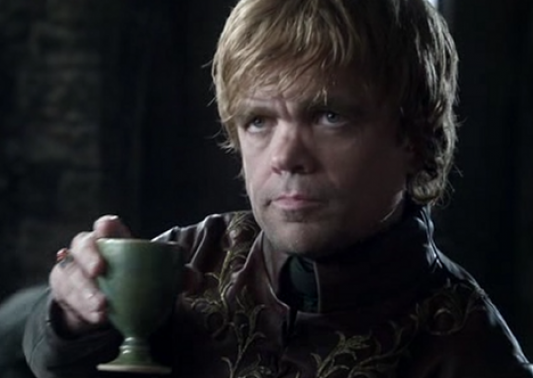
The next set-up scene is back at Winterfell. The characters of the king and members of his family are mostly set up before they are seen, in particular Tyrion Lannister, who is endowed as the boozing, whoring, dwarf brother of the queen who everyone talks about very much like the classic endowment exercise, Here Comes Johnny.


The final big introduction scene, introduces Viserys and Daenerys Targaryen, another twisted sibling relationship.
The brother comes in calling her name and when he finds her adds, "There's our bride-to-be!" The scene is set here. She's about to get married and clearly deadened by the prospect judging by her manner. That he is plotting to gain the throne is made clear a couple of lines later. There's hint of the abusiveness of the relationship but we don't learn that they are sister and brother until the next scene, but we know plenty about of their relationship by then and the fact they are siblings heightens it to disturbing extremes.

So, what can we conclude? I think it's clear that TV shows and movies use many of the same techniques of endowing that we use in improv. Even the blunt ones. People do come into a scene saying "Hey, sister!" etc. And although we might find it a little heavy-handed sometime, the audience doesn't mind as long as it gets the information it needs. And it doesn't have to have it all at the top. We can let it trickle out as we find out other information about the world we are creating. But making something clear as soon as it is established is important whether it's at the start of a 3 minute scene or a 6-season epic.

Monday, 2 June 2014

Improv vs Comedy

Like a lot of people, I got into improvised comedy because I enjoyed being funny. And like a lot of people over time I came to the realisation that comedy is not at the heart of improv, but the genre it is generally played in. In fact, comedy can often be at odds with improvisation.

A lot of comedy comes from breaking things. There is much comedy in destruction. Many a punchline reveals that things are not what they seemed. That's all very fantastic when it’s the end of a joke, but in a scene it can be hard to recover from. The rug has been pulled out from under the scene and you effectively have to start again. Jokes like these are called "gags" in improv – jokes that halt or destroy the action. They don't always seem so bad in shorter scenes, but they can be lethal if you are trying to get an audience to care about what's going on enough to make it last longer than 5 minutes. It is especially damaging when the gag reveals the situation to be sexual, gross, racist, sexist or other things like this. The laws of improv means you need to go down that path once it has been stated, which might have a very negative impact on the engagement of the actors and audience.

Other destructive forms are outright nos. Saying "no" is funny. Any form of spanner in the works can be very funny. Here's a classic example which nearly always results in a one-dimensional scene:

"You are a highly respected doctor with so much experience."
"It's my first day."

I've seen several groups who somehow manage to block so much for humorous effect, every offer seems to be inverted in the manner of the one above. If that's fine with the rest of the group, it can make for a show with lots of laughs. But I argue that these sort of laughs coming from the laughter response to surprise only work on a very shallow level, become predictable quickly and make it very difficult for the group to create something with any depth.

Laughs that come from connecting two seemingly unconnected things, from the characters themselves or from a great reincorporation are much deeper and much more satisfying.

Concentrating on the funny often leaves the relationships and story untended. People going simply for laughs will much quicker go into areas of sex, bodily functions or having a go at whatever racial group is out of vogue at that time.

Actors who concentrate on the funny are often the least supportive of their fellow players who tend to be the ones running around justifying the crazy stuff the one trying to be funny is saying. The problem, of course, is that the player going for the funny is (often) getting laughs, especially from people new to improv, so this is behaviour easily reinforced.

I don’t want to sound like I'm against funny. I'm not. I describe myself as a comedian and love nothing better than getting a room to laugh. But over the years I have, in improv, been trying to shy away from the selfish, destructive laughs and trusting that if we all work on making the scene awesome, there will be moments of humour that arise. In fact with the right group and experience, they'll arrive almost as much as if you block every offer that comes along and they'll be a hell of a lot more satisfying to everyone.

Are you with me?
(It's okay, you can say a big "NO!!!!!" here, that's actually a good out.)

Sunday, 27 April 2014

Cutting to the Chase vs. Building to the Chase


When teaching improv, we impress on the actors how important it is to follow through with something. If you say you are going to do something, do it. Do it straight away, before you get distracted by other offers and forget it or before you think too much about it and decide it's not good enough. This goes a long way to reinforcing doing what you say immediately as a central tenet of improv, but it isn't. It's just a good way to reinforce good habits.

So perhaps the real tenet is...

If you set something up to be done, you must do it at some point.

Photo by Véronique M
This means it is acceptable to set something up to be done, that doesn't get done immediately, as long as it gets done before the end of the story. How long it takes to get done depends on how important or daunting it is and whether there are steps that need to be done before. Also, sometimes the completion of a particular task will signify the end or beginning of the end of the story, so that's worth holding off from.

A clear example in a lot of shows is some big task that everyone is working towards: the ball, the race, the dance-off, the concert. Something that is important and it's happening will signify the end of the story.

Shakespeare is great at setting up deeds that must be done, and then spending a long time talking about them before they happen. This in improv is discouraged for newbies because this talking about it is usually happening as a way of simply avoiding doing it. In Shakespeare it is done to make the deed seem all the more daunting, and also to learn more about the characters who intend to do it. The scene of weighing up the pros and cons often gives us some of the greatest Shakespearian dialogues and monologues. ("If it were done when 'tis done..." from Macbeth and "To Be or Not To Be" from Hamlet.)

How long you wait to do the thing you set up depends on how important or difficult it is. If you say you are going to clean the car, you are almost certainly better off doing it straight away. If you are going to kill the king, a task which requires a lot of planning, guile and risk, then it's good to really build up that tension and make the act as huge as possible. Compare the anguish Macbeth goes through before killing King Duncan with the following snippet from an improv scene:
Alphabus   "I'm off to kill the king."
Betamus    "Okay."
The king enters. Alphabus stabs the king with a flourish. The king falls to the floor with a face of comedy surprise.
 The above is all very amusing and, boy did it cut to the chase, but in terms of drama and making us care about what's going on, it registers somewhere around zero.

Of course, it's much easier to start with, simply doing everything as and when it's set up. You reduce the risk of an offer being forgotten or lost amongst all the other offers, but that doesn't mean you can't take a moment to soliloquise on risks involved before getting down and doing it.

Photo by Mathieu van den Berk
So, in short, delay in doing something can be good, as long as that delay is to build up tension, importance, etc, or to visit other parts of the story or stories. But it's a real tightrope walk because simply delaying something isn't building tension. And simply saying something's important doesn't make it important, you have to show that it is important for the characters.

And it's good to remember we are talking about only a relatively small number of actions.  Generally, most acts that are set up should be done immediately: Stuff needs to happen throughout the story. A few things might be delayed in their execution and thus become important things. But it's still perfectly possible to have a story without delaying an event.

Perhaps it can be best put by paraphrasing the old impro saying, when you encounter the door with the monster behind it, you should open that door, but the door with the scariest monster can be saved until last.

Sunday, 2 February 2014

IMPRO Amsterdam 2014: Day 4

This blog is late. It was supposed to be ready yesterday, but life and workshops got in the way. But more about today tomorrow.

The festival has moved into the final phase that includes workshops for those quick enough to sign up. On Friday, I worked instead of workshopping, but did so in the style of a boy who wished he was a long way away.

Boxing. Photo by Mathieu van den Berk via impro-amsterdam.nl
Friday saw the last of the single-group shows, with The Raving Jaynes, who are improvisers who come from a dancing background. I know plenty about improvisation but what I know about dancing you could write on a ballerina’s butt.

Inspired by what was to follow, the host, Jochem Meijer, invented the best warm-up game ever. Put simply it got the whole audience to dance. Willingly. If you want to know more, go and see a show he is hosting and he might do it again.

The Raving Jaynes’ show brings together dance and improv. For the main part of their show they performed a single story with a mixture of improvised dance and improvised scenes which are generally kept separate. The dances linked the scenes, showed the inner life of the character or depicted big events in a stylised way. It is when dancing that they really come into their own. Their attention to what each other is doing is quite phenomenal. A routine is picked up by the other almost instantaneously. There was a little character confusion in the scenes and I think given that the dancing gives the show a strong abstract side, I wonder if the characters could be painted with bigger brushes.

Reviewing an earlier show, I complained about lots of abstract with no substance. The Raving Jaynes really showed how the abstract can have substance. How it can be used to depict emotions and dramatic events in a way that differs from typical improv which tends to be very literal or symbolic but still quite literal. Obviously most improvisers are not going to be able to suddenly start dancing with the same proficiency as two trained professionals, but it does show that movement and the abstraction of emotions, etc, can be used to great effect if a group so desires.

Hitchhiker. Photo by Mathieu van den Berk / impro-amsterdam.nl
The second half was Blockbuster, which started by showing 3 key scenes from movies in genres given by the audience. All three were great, high-impact scenes that the audience would have wanted to watch. But they had to pick one. They went for the thriller possibly because it was the last, but also I think because there were more unknowns in it. They then recreated the thriller with the same scene included somewhere in it.

The cast were really working together well, but it seemed clear the Austro-Americans were the driving force here. However, this is no bad thing; Their experience in this sort of thing is not to be underestimated. And I would certainly not go so far as to draw a parallel between this and story in which the holiday-makers were trapped and stalked by the characters played by the Austro-Americans.

The thriller ended up being more of a horror (the distinctions can be subtle), there was a fair bit of confusion and, of course, the original scene, when it reappeared, was a bit different. But the whole thing was played with gusto and some great physical work (not least, again, from the Mexicans) that it was enjoyable. It’s already a lot of mental work to for the players to make sure same scene comes back, so as an audience we do somewhat forgive some of the things that changed. (And as a group you could even justify it by saying a clip in a movie trailer is often different to the one that appears in the final cut of the movie because the trailer is often released before the film has been edited.) But, obviously, it’s a million times better if that promise to the audience is kept in it’s entirety. The other two start scenes, which were simpler and with less people, might have been easier to hit.

I personally think the show was made by the music. It was a thriller because it had a thriller soundtrack, created and put together magnificently by Wouter Snoei and Emil Struijker Boudier. Two hats off to them.

Again I missed out on the late night show, but it’s more important for the visitors to see a sample of what else the Netherlands has to off improv-wise that me. I can tell you Sleeping Together (or Het Bed In) is a great duo show about intimacy and relationships with the added excitement that real clothes come off.

Saturday, 14 December 2013

Paul Rudd and the Game of the Scene

A few people have asked me about finding the game of a scene recently. I’m still searching for a good way to not only describe what it is, but also how to teach it. I’m getting there.

An overly vague definition is that a game is something that is set up and repeated and explored but which is not what the scene is about. Games can be found in any aspect of the scene. Often they come from within the character itself – a catchphrase is an example of a character game, but also from character interactions or interactions with the environment. They often stem from mistakes – a mispronunciation of a word, for example, that then gets carried on in the scene or show, building and evolving. I remember a show where a Dutch performer translated “fridge” into cool-cupboard, from then on any apparatus became named like this. The over was the hot-cupboard, etc. This is a game.

It’s not confusing or accidental that it’s called the game of the scene because the rules of most improv games, if spontaneously started in a scene could constitute a game of the scene. Games like stimulus-response (where something one character does causes another to react in a set way), sit-stand-lie or dubbing scenes are games that really show this principal. With these games, the rules of the game happen in parallel to the scene. They have some influence on the direction of the scene but they shouldn’t take over. I think this is a big insight into what I mean by the game of the scene. More very soon.


In the mean time, here’s an example of a game in the real world. Well, at least the “real world” of actors appearing on talk shows which is actually a lot closer to an improv scene than the real world. Paul Rudd's Late Night With Conan O’Brian Game.

Sunday, 27 January 2013

IMPRO Amsterdam 2013 Brief summary

Yesterday was the final day of the IMPRO Amsterdam 2013 festival. It’s been such an inspiring week.

Three Falling showed us how two people can really allow a scene to go wherever it has to go and trust that the story will sort itself out.

Scenes from Disaster Movie
IMPRO Amsterdam 2013
The Improphets (Improfeten) boldly took 4 pages of an unfinished script and improvised the rest of the play showing that you don’t have to start from your own platform. This was in fact the most complex audience "suggestion" I've ever seen.

Domeka Parker showed how as a solo performer (as well as one with other players) you never need to have a lack of inspiration as long as you have the wealth of your life experiences and pay close attention to your own body.

Secret Impro Theatre let us see that you can have it all – you can muck about and be fun and playful with each other AND create a great story with good characters with honest emotions.

And the Disaster Movie at the end showed that you CAN have 25 people on stage all creating a coherent story.

There’ll be more entries as my brain returns and I have time to process everything.

Saturday, 27 October 2012

Of Dying and Death

When people start to improvise, the scared actor often looks for any excuse to leave the scene. One common one is to die. For this reason (and the fact that the player left behind probably won't have the skills or confidence to carry on alone), improvisers are generally encouraged (or told) not to die. This training sticks and is not helped by the generosity that improv engenders which means we don’t like to kill our fellow players or leave them stranded. Often there is also an understandable attachment to our own characters and a reluctance to have them killed off.

But we should realise that there are times when dying is the best thing we can do. It’s the right choice for that scene, story or situation. Death is a very big part of stories. Of the last 10 films you saw, how many involved people dying? People die in stories all the time. In a murder mystery at least one person HAS to die. Imagine a war film where nobody is killed? You'd probably want your money back. Historical dramas, Westerns, thrillers, science fiction... all of these are highly likely to feature someone dying. Even rom coms will knock off characters more than you’d think. How many times have you seen someone's elderly relative shuffle off her mortal coil after imparting some aged wisdom? See Four Weddings and a Funeral for a prime example of death in a rom com and fairy tales for plenty of examples of it in children’s stories.
Scene from Up!
Scene from Up!

Proponents of the Hero's Journey school of story construction will tell you that death is a big part of it. Death is very important as it shows the importance of this quest. It highlights that it is a life-or-death struggle. So death will be faced by the central character, maybe literally (as it often is in myths where the hero dies and has to be reborn), but often metaphorically (as in death of a way of a way or phase of life) or (as is the most often in modern stories) it is experienced through the death of a loved one or trusted aide.

So for the improviser, this means that if we are telling stories (and we are, even without trying), we should realise death is an important aspect of stories as it is of life. It is one of our greatest fears; it is the ultimate price that we can pay. And it is through facing, experiencing and maybe overcoming death that stories become more vital.

So don’t be afraid of death in improv. Embrace it. Have it in your arsenal of things that can happen so that when the moment is right and the story/scene feels like it needs it, it can happen and then you or the other players can deal with the consequences.

And if you are killed off, it doesn’t have to mean the end of your character or your involvement in the scene or story. This we’ll deal with another time.

Tuesday, 4 October 2011

Scenes should not be about what they say they're about

The same rules for screenwriting, go for improvisation...

Friday, 1 July 2011

The Perfect Form

A lot of comedy relies on the personality of the performer. Improv is rarely an exception. However improv is a discipline where the personality of the performer can actually get in the way.

In acting, certainly, the ideal is to lose oneself in the role. Become that character. However, that ideal is at odds with what the public seems to want. Many of the most popular actors tend to be people who keep the same character no matter what the role. Arnold Schwarzenegger, Sean Connery, Bruce Willis, Julia Roberts, etc. Most of the early Hollywood stars can be included as well. That's not to say they can't (or couldn't) act, but their success was in part due to a constancy in the characters they played.

Actors who lose themselves in a role tend to take a lot longer to get recognised by the public, basically because they are harder to recognise.

There is actually a very similar phenomenon in improv. The person who the audience goes home remembering is not necessarily the best improviser. He or she was the one who shone, who was the funniest, the one the audience warmed to the most or got the best line in. But he or she was supported, set up and allowed to shine by other players who yes-anded no less (and often more) than he or she did. In fact, sometimes, because audiences can often enjoy jokes that are at the expense of the scene, or having the ridiculousness of a situation directly pointed out to them rather than it being used to create a new world, and they do find utterly hilarious the destructive mischief of a deliberate block, it can be that the player the audience remembers and loves the most was, ironically, the most destructive player in that show.

When the direct audience feedback of laughter is all that is sought by a player or a group, it is very easy to fall into bad habits. Joyful, well-rewarded bad habits, but habits that can make telling longer stories or playing scenes with any realism or honesty difficult.

So, in the same way that the perfect actor is one who loses him- or herself in a role, the perfect improviser is one who loses him- or herself in the scene. That is by being, saying and doing whatever the scene needs regardless of their regular habits, the things they like to do, their usual way of standing, moving and talking, and their standard set of stock characters. And often at the expense of the jokes that keep appearing in their head.

It seems like the path to getting singled out for praise less, but, if your fellow players all think the same, you will find yourself in a group that can play or do anything: tell fantastic stories, make awesome scenes and allow rich, nuanced characters to emerge that will stay with an audience long after the cheap fizz of a knowing block.

Thursday, 2 June 2011

Third Party

This week I've been pondering on whether talking about a 3rd person (who isn't in the scene) is an inherently bad thing. My conclusion is that it isn't. As long as the scene doesn't become about that person.

As I've said before, a scene should always be about the relationship between the characters IN the scene. We discourage rookie improvisers from talking about people outside the scene, because it usually means the scene just ends up being a discussion about someone who isn't there.

But once improvisers are of an intermediate level, they should be able to have a scene where it's not about the person (or thing) they are actually talking about. A scene inspired about the word ball, will probably feature a ball quite heavily, but the scene should not be about the ball. (Unless the ball is a one of the characters in the scene.)


I'm not saying you should frequently talk about people who are outside the scene, I'm just saying it's not necessarily bad. I don't think it's a hard and fast rule that you shouldn't do it and that if handled properly, there is no solid reason why not to.

One way it can be used is if both people in a scene have a different opinion about, or a different relationship to, the 3rd person, then you can see how different the characters in the scene are. It's a way of illustrating differences between the characters and thus highlighting their relationship.

It's also a way of illustrating character directly. One thing I have realised about people is that when one person is talking about another person, they often reveal more about themselves than they do about the person they are talking about.

Certainly in real life what people say about other people are generally not proven facts, but an impression, opinion or judgement of that person.

For example if A says B is irritating, what that really means is that A is irritated by B. It doesn't necessarily mean that B IS irritating. B might be a rival, an ex lover or very pleasant which grates at A's grumpiness.

Obviously in an improv context where simplicity is usually the best policy, it probably does mean X is irritating, but it doesn't have to be.

Not only this, but how A talks about B shows a lot of information about A's character: Is he diplomatic, gossipy, superior, sympathetic, admiring, judgemental?

I agree most of this could come out in reference to the scene partner (except, perhaps gossipy), but my point is that if treated in a similar way to objects, characters outside the scene can be mentioned, even discussed at length as long as the real subject of the scene is the bond between the characters who actually bothered to be in the scene.

Friday, 22 April 2011

Transitions Workshop and the Movie Paradigm

Fade in.

I recently attended a workshop on transitions given by Tim Orr of longform trio 3 For All. It's a topic I'd covered with him before as part of a broader workshop, but one well worth revising. Especially as it is something I feel I've underused in the year and a half since the earlier workshop. Transitions are the moving from one scene to another, one location to another, one time to another, or one beat or sequence to another. So as well as the usual "edits" there is a whole bunch of other techniques that can be used not just between scenes but also during scenes. This includes techniques for performing multiple scenes at the same time, even in the same physical space.

Tim's mantra is to always ask "how we can make the current scene as magical as possible at any moment?" It's a great approach and is so much better for making wonderful scenes than the common mantra of "how can I be funny right now?" His approach, although he always talks about making improv more theatrical, is actually to make improv more like movies. This is definitely where my thinking is these days. Movies are the things we should have in mind when making improvised stories. Theatre has so many limitations – certainly in terms of making spectacular things happen – whereas in improv, where the set, props and costumes are all made out of the imagination of the audience, we are actually much, much freer to make anything we want happen. And I do believe anything can be made to happen. There is always a way to represent any situation or at least part of any situation. We just need to imagine how it could be done and to get everybody else on board with it. This is obviously not a simple task, but it is achievable with a group of people who are ready to let their imagination move beyond the confines of the stage, are prepared to take the risk and who are really, really working together.

I will certainly talk a little more about transitions in the future, but if you really want to learn about them, go take Tim's workshop.

Dissolve to www.3forall.com

Wednesday, 30 March 2011

Would Like to Buy: Transaction Scenes

When we first learn improv we are given a set of rules to follow. One of these is to avoid transaction scenes. As we progress, of course, we realise that many of these "rules" are more like "guidelines." The question I wanted to explore is: "Are transaction scenes inherently bad?"

The answer from the observation of scenes is that they are. Because very often they are dull and the same thing always happens. Here's some typical examples...

A I'd like to buy loaf of bread.
B Here's one. That'll be 2 euros please.
A That's too much.
B Then you can't have it.
A I don't want it now.
A leaves

As people learn to accept more, it doesn't really help.

A I'd like to buy loaf of bread.
B Here's one. That'll be 2 euros please.
A There you go. Thank you.
A leaves

Upright Parrot Brigade
However I've seen great scenes set around a transaction, so it isn't a hard and fast rule. The problem is because a transaction is an easy pattern that we fall into every day of our lives. A pattern where 95% of the time the people involved do not know each other and there is no emotion invested in it. A scene should always be about the people in it and their relationship, not about what they are doing. What they're doing is the vessel through which they can express their character, relationship and feelings.

There's a great exercise to help stop transaction scenes being purely transactional. Actor A makes a "bland" or "transactional" offer and B has to respond to by making it personal (i.e. have an established relationship with the other player and/or emotional). Examples...

Recognition of other character (relationship and hopefully emotion):
A I'd like to buy loaf of bread.
B Is that you Simon?

Regular customer (relationship and hopefully emotion):
A I'd like to buy loaf of bread.
B Well, of course, Mrs Habersham. I've got the usual all ready.

Emotional (not about other character, although the other character will probably become involved):
A I'd like to buy loaf of bread.
B Thank you for coming to help. But there's no way we can save the shop. I'll give you this loaf for free – it's the last one I'll ever make.

Relationship and emotion:
A I'd like to buy loaf of bread.
B (suggestive) Of course. Let me get you a nice firm one.

Relationship and emotion:
A I'd like to buy loaf of bread.
B Don't pretend you don't know me, Daphne.

So a transaction is not inherently bad, but it's a trap for inexperienced improvisers who don't want to make the scene about character, relationships and emotions.

And although the characters knowing each other certainly helps, this is not necessary as long as there is some sort of connection or attitude to each other. Two people who have just met who have a strong connection or clear attitude to each other can make for an interesting scene. This can be positive attitudes: They are attracted to each other or instantly really enjoy each other's company; even negative: they antagonise each other from the word go; or a mixture: A is suspicious of B who is trying hard to please A.) If Daphne has to go into the shop of her bitter ex-husband because it's the only place to get the medicine for her mother – that's one interesting transaction. But two bland people in a nondescript shop trying to buy something neither of them cares about – that is highly unlikely to make a great scene.


PS Whilst the Dead Parrot sketch is based around the premise of one of the characters lying ("it's not dead, it's pining for the fjords") which is really very, very hard to do in improv, the scene works because of the attitudes of the characters to each other and the situation are clearly defined and heighten each other. (John Cleese's annoyed insistence causes Michael Palin to lie which causes John Cleese to get more annoyed.) It's also an argument scene which transgresses another rule, but more on that can of worms another day.

Wednesday, 2 February 2011

Amsterdam International Improv Festival pt 1: Theatricality

This is the first part in a series of things that stood out for me at the 16th Amsterdam International Improv Festival.

Tuesday: Theatricality
Often in improv we forget that we have a god-like control of physics on stage and that we can use this and the audience's cinematic literacy to great effect. One great example of this was a fight scene between two boxers (played by the guys from Cia. Barbixas de Humor from Brazil), where both of them stood apart, facing the audience. And despite seemingly not being able to clearly see each other, each punch received the appropriate reaction and both went into slow motion at exactly the same moment.

Photo from http://picasaweb.google.com/festival.theatersport

Another example of using cinematic literacy was a girl (played by Yuri Kinugawa of Japan) in a wheelchair (which, as ever in improv, was played by a regular chair). But instead of the usual, chair being scraped and awkwardly jerked around the stage as the character moves, the chair remained static and because we saw the girl move the wheel and she was the focus of our attention, we accepted her not moving and accepted that it was the background that was moving, which was easy as it wasn't really there in the first place. The fact she was alone on stage at the time, made it easier. But I could see, with a lot of awareness and a little bit of practice, that the chair never need move and even turning with a dozen people in the room, could be achieved by the people moving, not the chair.

Saturday, 15 January 2011

Improv and The Graphic Novel Part 2: Jumps

This is the second part of my exploration of the useful things for improv raised by Understanding Comics by Scott McCloud.


Comics, as much as films and books, love to jump in space and time. These jumps often use an extension of the previous topic, closure, for us to be fill in the gap or make the connection. Moving to another time or place in a story is a great tool. It allows us to follow multiple threads, skip bits of the story we don't actually need to see, see the causes or consequences of an event or behaviour, or see parallels between events separated by time and/or space. There's so much more it can do. Here's an example of a time jump used to reveal a truth about a character.


Many types of transition are common to most media. The square area at the top or bottom of a comic panel is the equivalent of the narrator or voiceover in improv and movies. Or a jump can be obvious given the context: often based on the last thing said, such as: "Okay, I'll meet you at noon and the OK Corral."

Comics and movies are especially blessed with being able to use imagery to indicate movement in time and space that doesn't mean we can't learn from them. We can simulate or allude to some of these jumps (or edits).

We've all faked the wobbling screens of a flashback, but how many of us have morphed from one scene to another or been in a split screen with our old and new selves showing how different or similar their lives were? Have we ever described effects as the narrator, the way a book would have to? "As he pushed the button, the whole room went blurry, our faces lost their distinctness and objects hung in the air awkwardly. We were in hyperspace."

The medium of comics is by its nature a medium of jumps. With occasional departures, all comic stories are made up of multiple panels that are essentially pieces of frozen time. So comics, being distinctly discrete, in their depiction of events get to play with time in a way we as improvisers (being physical beings and unable to be anything other than continuous) cannot. But that is not to say we can't also play with time. McCloud talks a lot about how much of what goes on in comics goes on in between the panels – i.e. in the mind of the reader as he or she connects each panel. We as improvisers only really have those gaps during edits, but that doesn't mean we can't think about the time between actions and dialogue; or think more about the connections the audience has to make during and between scenes.

McCloud identifies 6 panel-to-panel transitions.

  1. Moment-to-Moment: the next panel is a very short time later. Very little has changed and very little if any closure is needed to interpret what has happened.
    The gunman steps a few paces forward. The girl's smile gets bigger. The flying bird is a little further away.
  2. Action-to-Action: one subject is shown doing one action after another; the actions are connected.
    A man drops a coin; he stoops to pick it up.
    A golfer hits a ball; he puts his hands to his eyes to look in the distance.
  3. Subject-to-Subject: The subject changes, but the scene or idea does not.
    Someone kicks a ball into a goal; a crowd cheers.
    A monkey dances, money is dropped into a hat.
  4. Scene-to-Scene: These are significant changes of time and space, but still there is some connection.
    Man and woman under a sunset say "Forever" to each other; we then see them both angry on different sides of a court.
    "We'll never know what happened to the Rajeeb Diamond," says a policeman; A caption says "meanwhile in Peru" over a bird struggling along with a large necklace in its beak. 
  5. Aspect-to-Aspect: is where we see different aspects of a scene, idea or emotion.
    A set of pictures conveying the same place from various angles and distances.
    A clown, happy children and a smiling cat.
  6.  Non-Sequitur: This is where pictures have nothing in common whatsoever. However the human mind is so adept of looking for patterns and connections, and so wants to find them, that it's almost impossible to have two things that aren't in any way related. Especially to improvisers who are trained in making these sorts of connections.

So let's look at them more from an improviser's point of view.
  • Moment-to-Moment and Action-to-Action happen during a scene and are perhaps demonstrated best by that exercise where you break down every single movement into a simple, discrete steps. For example to pick up a piece of toast, you put your arm out; open your fingers; put them around the toast; close them; bring hand up. It's possible to divide this different ways and you can always break it down more (or less). You can think of how much you break something down like this as an indication of how important it is. For example, the moment the young man kills his first deer in a film or book would probably be shown (or described) in great detail and perhaps slow motion.
  • Subject-to-Subject is usually demonstrated by focus shifting to other characters in the scene or by a cut-away scene. Or it could be done by a narrator adding some extra details or unseen actions.
  • Scene-to-Scene is where most improv edits fall so doesn't need to be expanded here.
  • Aspect-to-Aspect changes is usually achieved in a brief montage where we see three quick establishing scenes about Christmas. Or by one or more narrators or characters describing different aspects of a scene, event, etc.
  • Non-Sequitur is either surrealist randomness or it's the gap between scenes in the first round of a Harold or similar collection of (usually) unrelated scenes. Although even then, there are usually plenty of connections if you look for them.

This list might not be directly applicable to improving your improv, but the more aware we are of time and space and how much control we have over it on stage the better. It can only help to make us stronger performers; more in control of every aspect of what happens on that few square feet of wood where we do our magic.

Thursday, 13 January 2011

Improv and The Graphic Novel Part 1: Closure

I recently finished reading Understanding Comics by Scott McCloud. I'm not really a big follower of graphic novels, but this book was recommended as being really about storytelling.


It certainly covers a good deal about storytelling, but mostly in the context of depicting said story in sequential boxes and it also has other line-drawn axes to grind . Having read it, like all good obsessives, I asked myself, how can I apply this to the thing I'm obsessed with? There is a good deal that can be applied here to improv.

What was good, was that the book was also written by an obsessive and it's great to see obsessives from other media especially those who have made a success of it. It's great is to witness someone enthusing about an art form that's very comparable to improv in that it's an art form often perceived as a hybrid, i.e. made up of other art forms. An art form that is often sidelined and looked down upon, yet is actually more adept at communicating directly to people than others that are generally more highly regarded.

Over the next few weeks, I'm going to go over the concepts that I think can be readily applied to improv that this book brought to my attention or reminded me of. Starting today with...

Closure

Closure is the human mind's ability to fill in gaps in what it sees [1]. McCloud puts it as "observing the parts but perceiving the whole" [p63]. Or put another way, "if something is missing in an otherwise complete figure, humans will tend to add the missing parts." [2] Examples are usually given in terms of shapes. For example, circles drawn with dashes that even though it could be seen as series of curved lines, we clearly see it as a whole circle. But it's the same when we see just the front of a car or the end of a box of cornflakes, we assume with such conviction that the rest of the object is there, lurking around the corner or behind the other packets.


It also works in the written and spoken word. Ellipsis, where parts of a sentence are omitted (and sometimes replaced with three dots called an ellipsis), is often an example of this. E.g. in "He gave Sheila the coat; and Gavin the knife," "he gave" is omitted before "Gavin" as the meaning is clear without it. It even works for parts of words as in the flowing examples: "Look out for the skellton!" "I hope I've may my point."

Great closure example (c) 2009 logopond.com

In terms of storytelling, closure in this sense means things that are omitted that are filled in by the audience. For example: a guy goes sleepily into a room and then emerges rubbing and opening his eyes. Here we automatically assume he's been to sleep. We didn't see it, but we know the normal sequence of events and this fits the pattern.

For another example, Jack shouts angrily at Allan; In the next scene Allan is lying on the floor and Jack has a clenched fist. We know Jack just thumped Allen without even having to see it.

Horror films use it a lot. Especially older or low budget ones or those going more for suspense than gore. We see the shadow of the creature approach the terrified girl, and then we cut to a tree. There is an ear-piercing scream and the birds fly off. We know it was the girl who screamed and that the creature has got to her. In fact even seeing the shadow of the creature involves closure, because we don't see the actual creature but we know shadows don't move about without the thing they are the shadow of. (Mysteries and thrillers actually take advantage of closure all the time. Often to throw us off the scent or make us think the story is going down one path. It's something we might deal with later.)

So closure in stories involves the audience filling in things or events that they don't see either during or in between scenes. It's very useful. It means we can skip whole chunks of things that the audience knows are going to happen or that are obvious from what is already happening.

It has great benefits for improv. It means we can don't have to show every single little thing to the audience. There is scope and precedent for omitting scenes or chunks of scenes. Especially, for example, later in a long form when we're racing towards the end or when a character has to do a lot of preparations. Take the situation where the hero suddenly needs to go and get a hat to get into the Hatters' Ball, we could simply have him declare he needs to get a hat and see him in the next scene proudly putting on his new hat. We don't need a scene of him entering the hat shop, choosing and buying that hat, delaying what we really want to get to. A less dramatic and more common improv example of closure is starting a scene in the middle.

I could fill a whole book with examples of this from movies, but all we need to know is that where the audience can easily fill in the gaps, we do have the scope to miss obvious parts of the story out and jump to the more interesting bits. It takes some practice to be sure, you're missing out bits the audience will assume happened and not need to see. Otherwise what the audience thinks is going on and what you think is going on might be radically different. And that's not good.


Scott McCloud has since written a new book much more about the storytelling and I hope to have a look at that soon.