Showing posts with label Movies. Show all posts

Monday, 21 July 2025

The End of the Story

 "Why can't these writers come up with endings that work?" 


This sounds like a quote from some modern-day film producer or book critic. In fact, it was written by Aristotle who predates movies and the printed word by a good few years. 


Endings are hard. Have you ever sat through a perfectly good movie only to be disappointed, confused or even angry at the end? One of the problems with endings is that the really satisfying ones are often also the most predictable. This is partly because the ending we want as a viewer is the one that does all the things we are hoping will happen. As a writer, sometimes the job is to get to this end in a way that looks like you won't get there or provide an end which is original. There is a need to be creative amongst writers that can make going for the obvious distasteful.  


In improv, obvious is very much our friend.
Doing what is obvious to you and hopefully the group allows you to build a story in steps that keeps everyone on board and allows you to make a longer, more cohesive story than if you take big "creative" steps.


The ending in an improv scene or narrative can also be obvious. It should, in general, be a tying up of as many things that have been established as possible without it feeling overdone or trite. And given the fact that improv audiences are more forgiving than moviegoers, knowing as they do what is being done is being made up there and then (and not been in production for the best part of a year), you shouldn't worry too much about overdoing it and certainly you should not overthink it. 


Surprise endings in general rarely work well. It’s fantastic when they do (these are the story endings that get celebrated), but so often they don’t quite get it right. Even in movies and books, where the writer has time to put enough subtle clues in so that the surprise is surprising but also still satisfying, I would say most attempts at a "surprise ending" don't please the audience. In improv, we can't be nearly so clever as to pepper subtle clues to something we have no idea about at that moment. Truly random ends to stories with no clues to them are the ones that make people the most confused and angry. Many people reading this will recall improvised stories they were in where at the last minute something unexpected was introduced that became or triggered the end. 


The satisfying ends are when something that has been struggled or searched for is finally achieved or found. Or it is not found, but the characters realise something important about themselves, in particular that they didn’t need it and what they really needed they had all along. A good end comes from a clear want or need, either of the central character or the group as a whole. In fact, a very satisfying story sees the group get what they need, the hero gets something they wanted, and the antagonist gets what they deserve. Another common end is to end up back where you started but with a new perspective. 


That’s
not to say all endings should be like these. Tragic endings are the opposite, where the protagonist doesn't get what they, the group doesn’t succeed, and, indeed, everyone might be dead. These absolutely work for some types of story. And in between are the perhaps more realistic “poignant victories” where something has been achieved but at a cost.” Some endings are deliberately anticlimactic or ambiguous. Some genres demand it. But they should still feel true to the events and the world of the story.


The end is a hard time, but we are instinctive storytellers. It might be hard to know what to do for an end, but when an end happens, we feel it. The audience especially does. I have been at enough shows where the audience has felt the end and is surprised the story is continuing. Sometimes leading to a further end or pleasing “denouement” but mostly not. 


So, if you have listened hard throughout, stopped making up new things after the middle, played and explored the characters, situations and world you have, realise what the characters want and need, and set the on the path to achieving that, you’ll be on your way to something that feels like an end. 


Monday, 5 April 2021

Genres: Dystopian Bureaucracy Example

Poster for the movie Brazil (1985)
Brazil poster

For a recent workshop, I did a lot of research into dystopian fiction. Part of which meant rewatching Terry Gilliam’s 1985 classic Brazil. The film has nothing to do with the country, it's just a song that plays a lot in the background. It’s a film where you have to explain the title, but titles have never been Gilliam’s strong point. 

Brazil is a one man against the system comedy / tragedy set in a terrifying vision of the future. It is both a dystopian movie in it’s own right, but also a satire of dystopian movies. I’m a huge fan, but understand that some people dislike that it is trying to be too many things at once. 

But, anyway, there is one scene that I love as a satire on bureaucracy gone wild and the reluctance in such societies to take responsibility. Plus, there’s a slapstick take on surveillance culture. All in one short scene.

As a bonus, enjoy the nod to 1984’s oxymoronic slogans that opens the next scene.

Enjoy.


Wednesday, 16 October 2019

Genre Guru: Tips for Playing Horror

It’s the season when many a good improv group says to itself, “Let’s do a horror show!” To help you scare responsibly, here are a few tips.

Take your time at the beginning. Most horror movies have a slow build. There is also a bit of time before the scary things start happening. Use this time to set up your characters and relationships and only hint at the horror. After all, the more we care about your characters the more we will want them to succeed and the more we will feel the wrench if they get sliced.


Start small and build. In most horror, there is a real build in not only the level of things happening, but the tension. The first scary things that happen (such as books falling off shelves, a dead bird being found, etc) are barely noticed by the protagonists. Practice building tension. Tension is hard to maintain in a comedy show as laughter is a big releaser of tension.

The same is true of the protagonists fear. Obviously they must be afraid otherwise the horror has no impact, but it can start small and build. Your character will be terrified, but you don’t have to be so from the start. It’s tiring for the actor and it’s tiring for the audience.

In movies, there is often a scare at the start: a kind of prelude to the coming horror. But the main reason for this is otherwise, there is 30 plus minutes with very little horror which is hard on a movie audience who wants the horror now! Unless you are doing a 2-hour show, you don’t need to worry about doing this, although it is an option to have a little taster of what’s to come.


Scepticism is allowed. Normally being sceptical or not believing what is happening or being said is a real killer for improv scenes, but it’s okay for the protagonist to be sceptical in the early stages of the horror. It is very much in the genre for the hero to not pay attention to the books falling off the shelf, or to attribute weird sounds to everyday occurrences. In fact, there’s a built-in game of scary thing happens and giving it increasing implausible explanations. Of course, at some point the protagonists must realise the horror is real.

Allow characters to die or disappear. But again, don’t rush this and remember this is a big moment.


You only need one type of monster. Improv stories tend to have too much of everything, and improvised horror is no exception. You don’t need to have a vampire and a werewolf and a zombie and haunted clock; you only need one.

Sometimes it’s scarier not to show it. Makers of low budget horror movies have realised that they can’t compete when it comes to special effects. But they don’t have to compete. Some of the scariest movies have hardly shown, or not shown at all, the monster. It can be more effective to show someone scared of the gorgon or someone recoiling in horror at the sight of the gorgon than have the reality completely destroyed by someone pretending to be a gorgon. (See especially The Blair Witch Project (1999), Paranormal Activity (2007) and Night of the Demon (1957).)


Do not play just for laughs. There has to be some jeopardy and some fear. Depending on your show, you might go more for the jokes, but you need characters to be scared. If it’s all jokey, then it’s a lame parody of horror. Given that most improve is dedicated almost entirely to getting laughs and little else, the more scared you allow your characters to be, the more like a real horror show it will be and the more your show will stand out. My advice would be to rehearse pure horror cos your team probably doesn’t need to practice the funny and when you have an audience the funny will slip out of its own accord.

The evil can be defeated. Finding a way to kill it, remove it or send it back to whence it came is an important part of the story. It gives the remaining characters hope. It doesn’t mean you do kill it, it means you can try. In many stories, you will succeed, in others you fail. However, even if you succeed, you might do so only to find that was just the tip of the iceberg or you merely angered something bigger and scarier.


Have fun. Enjoy playing a scared character. Enjoy being frightening. Enjoy being part of a rich story-telling tradition.

---
Peter is performing two horror shows in the coming month and has a super mega genre workshop coming up real soon. Contact him for details.

Wednesday, 30 May 2018

Walk This Way: Walk-on Examples

My last post dealt with the subject of walk-ons and there were a few things I left out despite it being a bit long for a blog post. There are a couple of resources out there, which you might find helpful. There are also examples in a lot of movies (and plays, books, etc) that show this is not just an improv phenomenon.

To recap, walk-ons are a simple idea that can be a very effective tool. They can also easily get overdone or steer a scene in the wrong way.

Let's start by looking at examples in popular culture. I had a lot of trouble finding good clips because they are by their definition not hugely important, and usually they are not memorable. They are not meant to be memorable. You might remember the message they bring, but not the messenger. Which is mostly how it should be.

In movies, they are usually little more than a talking extra. The character that comes on and gives a report of what's going on is the classic. Or the character who adds to the terror by screaming "Oh, my god, it's huge. It'll destroy us all!"

In movies they don't actually have to walk on, because the camera can cut to them. But any character with who we see briefly and has one line, or only a few lines, is a walk-on.

A classic scenario for a movie is that an authority figure is approached by a second character, This second character gives a report of the current situation, is optionally given an order and leaves (or becomes once more a background figure). We'll take a look at a couple of a couple of examples. There might be spoilers, but mostly these are classic movies so if you haven't seen them yet, you haven't been trying.

There's a classic one in the original Star Wars movie, which is hard to find a good clip of, where an imperial officer enters and begins, "Lord Vader, the battle station plans are not aboard this ship! And no transmissions were made," and then pretty much leaves.

This is from the same movie and shows that it's not just humans that can do walk-ons, but also mouse droids. It's more comedic than explanational, but it is more than simply comic, it also highlights something of the characters we are following.


At the start of this next clip, from the classic nature-turns-on-man horror/thriller, The Birds, there is a walk-on which heightens the tension and unease of the main characters.


In Jaws, Harry, the old man on the beach character has a two-part walk-on. To first, heighten the tension and give us a false scare and then to give us some character exposition about the main character.


The final clip is a classic joke button at the end of a scene type walk-on (or in this case a CUT TO). In fact it's probably the most famous punchline end to scene by a walk-on character in the history of cinema: “I'll have what she's having.”


Some people might point out that the character is briefly shown earlier, but this is fine. Walk-on refers to the characters role in the current scene or moment, not their function in the whole piece. Here the character went from being background to being a walk-on.

Having an established character do a walk-on is perfectly fine, and happens a lot in movies and TV shows. The Simpsons is full of established characters who do walk-ons all the time. One of the clearest examples – and most used – is Herman Muntz and his iconic "Ha-ha!"

As they said in the movie Walk-On Club: “The first rule of Walk-On Club is you do not walk on unless it is absolutely necessary.” The second rule of Walk-On Club is once you've done the thing you were doing, walk the feck off stage.”

Other Resources

I got a lot of inspiration for the videos from The Greatest One Line Movie Roles from the Overthinking It channel.

Here's a great set of succinct list of questions you could ask yourself before doing a walk-on from Jimmy Carrane.

Saturday, 27 January 2018

IMPRO Amsterdam 2018 - Tales from the Garage

Flicker is a format by Katie and Chris of Project2 and one I was lucky enough to be in. The simple explanation is that half the scenes are played in the dark and the other half in the light. The scenes without light force you to use sound to create radio plays or soundscapes. They also hopefully remind you to be more physical in the scenes where people can see you. It certainly produced some fun scenes and made for a show with a strong visual identity.

Scene with the lights on (Photo by John Mabey)

The second half was given over to Dad’s Garage. Dad’s Garage are a theatre with a good reputation based in Atlanta in the US. What do they make in Dad’s Garage? Well, lots of things, but tonight two of them showed us Working Title, which is an improvised Hollywood movie. Using the language of movie scripts to help paint and link the scenes, they get a description of a hero from the audience and two very different locations and launch themselves into if. Our hero then somehow gets from the first location to the second one, far from home and what he knows. They hit all of the beats of a good script and clearly know their movie structure. So the show has a well-structured story with some action, a little romance, camera pans and a satisfying end where everyone feels good. But it’s all done with a ton of confidence and a lot of fun, discovering the story as they go and following the twists to their conclusion.
Lights on, cameras on, actions (photo by John Mabey)
After the main shows, there were 2 options as previously:

In one room, most of the cast of the main stage shows ganged up and threw down a show. It was basically a talented bunch of friends putting on a show simply for the joy of what they do.

In the other room, BAFNI from Scooby Doo, I mean BAFNI the Vampire Slayer, I mean BAFNI from The Czech Republic performed. They took stories from themselves and the audience to inspire them in all directions.

I know I promised lots of gossip, but I think everyone is too sleep deprived to cause scandal, or I’m too sleep deprived to notice it. All I can say is that in the green room there is a teddy bear groupie that partied way too hard this week.

Fight's on! (photo by John Mabey)

Saturday, 2 September 2017

Ten lessons for improvisers from the movie Alien

Alien (1979, dir: Ridley Scott) is a great example of a science fiction movie. You may have seen it. Frankly you should have seen it. I don’t think you need to have to follow this post, but why resist seeing it, you’re only depriving yourself.

Improvising in science fiction is fraught with danger. These dangers are the same that film-makers also face. So looking at a successful science fiction movie can give us some insight into how to do it well. The same goes for horror, which is relevant, as we will see. Let’s look at Alien and find ten lessons about improvised genres and improvised narratives.

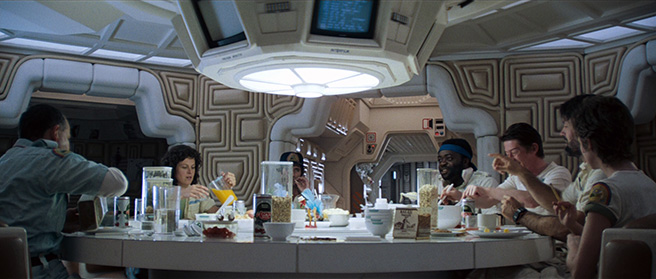
People still eat, no matter what era it is.
  1. People have always been, and always will be, people. People in science fiction don’t have to be weird, unrelatable aliens. In fact they rarely are. The crew of the Nostromo are blue-collar workers doing a hard job. They are the crew of a towing vessel. Today they would be the crew of a freighter. They are all people we could and relate to in our ordinary non-future lives. 
  2. Establishing character through dialogue. Our main introduction to the crew is through a conversation over a meal. Here they chat, joke, argue and generally show their outlook on life through how they talk and what they say. Again, it should be noted, they are not talking about weird space stuff, they are talking about getting paid and what their job entails, and the sorts of things we talk about when we’re at work. People will not be radically different in a few hundred years time.
  3. Science Fiction often has another genre. Although most people would say the genre of the movie Alien is science fiction, the story is pure horror. Science fiction is almost always a filter put over the top of another genre. At least, that’s how I like to view it. Science fiction is actually very broad as a genre, and in a way gives us very little concrete to start with, and plot-wise gives us even less. A science fiction story can be set in any time or place, both real and imaginary. It doesn’t have to be set anywhere near space. However, if a story is set in space, it is automatically science fiction. (At least it will be until space travel is boringly routine for us as a species.) Alien goes for what could be called a classic setting for science fiction, a space ship. But it is not an exploration ship on a voyage to explore new planets; it’s not a battle cruiser off to battle against the interplanetary federation; no it’s basically a tug taking a cargo of something mundane back to Earth.

  4. Relationships. It’s important to establish the relationships of the main characters early on in a story. A lesson here is that, most relationships are not going into in much depth. This is not a relationship-driven story and in fact not so much time is spent on it, but you do get to learn some of the connections that people have to each other – it’s mostly who gets on with whom and who doesn’t get on so well together. This is partly because there are 7 characters at the start and so we can’t keep track of 21 relationships. (The equation is n(n-1)/2, if you were wondering.) It’s also because horror is not (usually) a relationship-driven genre. The action is not dictated as much by the actions of the main characters as it is by some outside entity. Plus most of the people you meet at the beginning ain’t going to make it. In horror, as a rule, we don’t follow and identify with the main characters because we are fully invested in their character but because we empathise with their predicament and don’t want them to be brutally murdered.
  5. Alien is not about the alien, but about the crew’s attempts to avoid getting killed by the alien.
  6. Baby killer aliens can be cute too.
  7. Gore or lack of it. Although we see some of it, we don’t actually see too much of the alien killing the victims. Horror (aside from the gore and slasher subgenres) is much more about the build-up of suspense and the reactions than the actual horrific acts. Which is good for improvisers as it’s hard to mime a good decapitation. Especially one that isn’t funny. But atmosphere and reaction we can do. However, the trick is that atmosphere and reaction require total commitment to it. Which sounds like the realm of improv, but, in improv the commitment is often only to the funny, and applied far less to the dramatic or real side of things. But with commitment (and good music) a scary atmosphere can be achieved pretty easily. One good tip is your character should genuinely be scared. At no point in the movie do you think, “that actor is just playing scared.” You certainly don’t see what you too often see on an improv stage, a character playing some sort of vaudevillian, knowing spoof of a scared person. You see the fear of the characters. That’s the only way horror works.
  8. Establish the rules of the world. Some sci fis have wildly different rules to the world we know, but most don’t. The one’s we relate to most do not have that much which makes it alien to what we know. There should probably be some new rules, as this is an important part of sci fi, but there do not have to be many. And the characters are usually used to the rules of this world, and so live them, understand them and are not surprised by them. Rules can be small or large. Things that are different have to be explained or demonstrated. In Alien it is explained that they have to respond to the SOS beacon because that’s one of the rules AND that their pay depends on it. Also, the rules of the autodestruct system (in particular that there is a time-limit to the over-ride function, which only makes sense plot-wise) are explained by the autodestruct’s own voiceover. Also in Alien it is enough to show that steam coming out of vents at various points of the ship is a regular thing for us to accept it is an important part of the workings of the ship, even if part of us doesn’t get why, once we see it a couple of times, we accept it as something that happens in the world of that ship.
  9. Technology changes the way we do some things but we are still humans. We won’t spend all of our time talking about technology (okay, some of us will, but most of us won’t), but we will use that technology in our everyday lives. This is easier to do in a movie where we can show so much without having to talk about it, but even in stage-bound improvisation, we can have scenes where we have a lot of new technology around us, but we just use it rather than talk about it or over explain it. Note this last thing is not just a trap for improvisation, but a lot of terrible sci fi does it too. The trick is to talk about what’s going on with the characters and not about the tools you are using.
  10. Androids and robots are only really interesting when they have or want human emotions. The biomechanical android is so convincing as a human, it only becomes clear it’s an android when it’s head gets knocked off. And although looking back, the seemingly emotional choices of the android had a less emotional driver, it does reveal some emotions we can (sort of) relate to in that it has the capacity to admire. Although it admires the alien for being “unclouded by conscience, remorse, or delusions of morality.”
  11. In horror (certainly since the seventies), just when you think it’s over, it isn’t.

  12. Attitude.

    Any other lessons you’ve seen from this movie? Any alternative takes you have? That’s what the comments are for.