Showing posts with label Acting. Show all posts

Monday, 10 April 2023

A Sort of Apology

This blog has been dormant for a while. It’s not because I have not been thinking about improv; I have. A lot. I just have had very little time to write those thoughts down and edit them into something coherent. I also had an intention to do some of them as video or audio, but this takes even more preparation and editing. I think in here is the essence of why I have done improv for so long, the fact that you just have to turn up. There is no script to learn, no props to bring, no specific outfit to have prepared.

Obviously, I have prepared. I have rehearsed a lot with the group ideally but even this is often just turning up and playing. And I have taken courses, etc to which I had to turn up and absorb. And play.

I am clearly ignoring a big part of the preparation for a show – someone has to find and book the venue, plan who is in it, promote it, organise guests, musicians or other external performers. And for rehearsals, someone has to find and book the venue, organise a coach, make sure enough people can come. But for people who are just players, a lot of improv is just turning up and being there. But it spoils you for when you have do something preparation-heavy such as acting or stand-up, or something post-performance heavy such as video making.

Anyway, this is turning into post rather than a brief note to say there will be more posts coming soon. (Cynical editor: Cue another long hiatus.)

Friday, 7 August 2020

Online Improv: Zoomed Out

Very few people would have predicted that we would all be doing our shows online so soon into the future. But that’s what has been happening. And as many of us discovered or are discovering, it’s not the same as doing it on stage. Whilst a lot of the core skills are transferrable, there are some things that are very different.

One huge difference is the lack of an audience and the direct feedback of an audience responding and thus shaping what we are doing. The shows lose a lot of that “live factor” which is a big part of the appeal of an improv show for an audience and is the reason that even the best improvised TV shows have none of the excitement of seeing it live.

Probably the biggest hindrance for performers is not being in the same place as our fellow players. We can’t truly look them in the eyes and get that deep connection. There is a lag in the conversation so our reactions don’t feel in the moment as much as in several moments ago. We can’t often be as big physically as we once were as we’re either performing within a narrow rectangle or we’re sitting down. This leads to a lot of ‘talking heads’ scenes where two actors just stand (or sit) there and talk with little movement or emotion.

Part of what makes it difficult is that we are trying to apply our skills to a new medium. We all learnt the core skills of paying attention and reacting constructively, and at the same time we learnt how to express them on stage, in a theatre setting. We call ourselves improvisers, but we could more accurately call ourselves “stage improvisers,” the same way you talk about “stage actors” and “screen actors.” The main reason we don’t is that screen improvising didn’t happen all that often, and when it did, it was usually done by stage improvisers and the setting was usually stage-like. Or it was done by screen actors and it was only part of a thing that was mostly scripted.

But now screen improvising is happening all the time and we realise they are different beasts.

As an actor, the transfer from stage to screen is often a difficult one. If you are used to performing on stage, you are used to projecting so the whole room can enjoy you. Bellowing like that into a mic will not win you many friends. You are also used to injecting your emotions into your whole body, often exaggeratedly so. In acting on camera, less is more.

The style of improvisation that many of us learnt (cheeky, exaggerated, stage comedy a la music hall/vaudeville) doesn’t really work. We have to take our inspiration from TV acting. It can still be exaggerated and comic, but within different parameters. Acting for screen is smaller, but still there is energy and intensity, it’s just very often internalised.
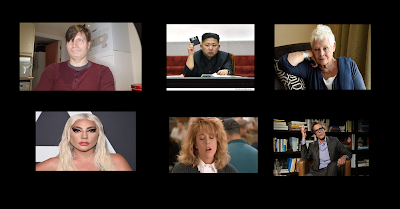
Sets are another limiting factor. In improv, because the action can be set literally anywhere, a group will either perform in front of a neutral curtain with some plain chairs for everything else or have a million pieces of furniture all lying back stage and a set of stage-hands ready to deploy. At home, the default choice would be to find a blank wall or hand a neutral curtain. As any visible furniture kind of gives a location. If you have the time and your device is portable, you can quickly create a location in another part of your house to best represent the next scene, but again, this is can be a distraction or possible delay although can be impressive if pulled off well.

Now there are virtual backgrounds, but not everyone can use them and quite often they are more of a distraction than something that genuinely sets the location. So be careful. Practice using them with your group but see how you (all) feel about the results. Unless everyone has devices that can handle it well (and not all can) and you know how to set them up quickly, they might just get in the way and take you away from being in a few moments ago.

The place where there is a real win is props. On stage, miming objects makes so much sense. In improv, most of the time we don’t use them, because you either have a large enough collection of them that you can find something usable or you have nothing and mime everything. (The middle ground is where you have a limited set of props because you know the setting / genre beforehand.)

Miming, however does really work on screen. Fortunately, we are mostly performing at home now, so we have within a short sprint, practically a full set of everyday household objects. (Maybe the history of improv ask-fors hqas been leading us to this moment. “Can I have a house-hold object and a room in a house?”) If you know there are things you are likely to want in a scene, it just takes a little thought to have them available within arm’s reach.

One other area, we have to adjust is in our director’s heads. As improvisers, we have different heads: we are actors, co-writers and co-directors all at the same time. But there are big differences between directing for stage and for screen. So instead of thinking about where we are on the stage, we can think about how far we are from the camera and where we stand in the frame. We even have extra choices we don’t often have on stage, such as extreme close-up. We can even play with angles in a way the stage doesn’t lend itself to.

All these are things an audience understands and to a degree expect having been watching TV for much of their lives. We also, really, should be thinking about what’s on screen: i.e. the shot the audience is seeing. A dialogue on TV will usually cut between the two speakers, but the convention for an improv show is that the two people keep their video on. The main problem being that as it usually has to be controlled by the actor and switching your own video on and off is clunky, but some conferencing software allows a host to control what is seen and I’ve seen some shows using live-TV software. Both of these mean that actually means the role of a director (or live editor) makes sense. Very much the way it makes sense to have a lighting improviser in many venues.

A director can swap between views and “pin” specific videos to simulate cuts between actors, they can share pictures or video to set up locations, they can share music for emotional or dramatic moments, especially when there is no dialogue.

Actually, music can be a place online shows struggle. With the lag and the fact speaking often cuts out other sounds in Zoom, for example, it’s impossible to improvise songs, except when the music comes from the same place as the singer. Indeed, speaking over music can be problematic on things zoom unless the speaker is the one sharing the music, which makes it yet another thing that most actors never have to think about.

I’ve very much taken the stance that our inspiration on how to produce content should come from TV. This is my opinion. 

Perhaps we should look at the other online phenomena such as podcasts and vlogs and make things that are less visual and more like stuff to have in the background whilst cooking. This is presumably why many improv groups have gone the way of live discussions about improv as part or all of their online output.

Or we maybe we should look at youtubers and go for lots of short content with running themes, with the emphasis perhaps on editing.

Or we could take our cues from TikTok and simply lip sync to sound clips from Whose Line Is It Anyway.


When I started writing this it was very early in the whole lockdown thing, other things kept usurping it. It seems less good timing with many places going out of lockdown. But with a potential second wave may be it’s pertinent still. Plus, I don’t think the concept of online shows will completely go away just because virus does.


END CREDITS


Wednesday, 16 October 2019

Genre Guru: Tips for Playing Horror

It’s the season when many a good improv group says to itself, “Let’s do a horror show!” To help you scare responsibly, here are a few tips.

Take your time at the beginning. Most horror movies have a slow build. There is also a bit of time before the scary things start happening. Use this time to set up your characters and relationships and only hint at the horror. After all, the more we care about your characters the more we will want them to succeed and the more we will feel the wrench if they get sliced.


Start small and build. In most horror, there is a real build in not only the level of things happening, but the tension. The first scary things that happen (such as books falling off shelves, a dead bird being found, etc) are barely noticed by the protagonists. Practice building tension. Tension is hard to maintain in a comedy show as laughter is a big releaser of tension.

The same is true of the protagonists fear. Obviously they must be afraid otherwise the horror has no impact, but it can start small and build. Your character will be terrified, but you don’t have to be so from the start. It’s tiring for the actor and it’s tiring for the audience.

In movies, there is often a scare at the start: a kind of prelude to the coming horror. But the main reason for this is otherwise, there is 30 plus minutes with very little horror which is hard on a movie audience who wants the horror now! Unless you are doing a 2-hour show, you don’t need to worry about doing this, although it is an option to have a little taster of what’s to come.


Scepticism is allowed. Normally being sceptical or not believing what is happening or being said is a real killer for improv scenes, but it’s okay for the protagonist to be sceptical in the early stages of the horror. It is very much in the genre for the hero to not pay attention to the books falling off the shelf, or to attribute weird sounds to everyday occurrences. In fact, there’s a built-in game of scary thing happens and giving it increasing implausible explanations. Of course, at some point the protagonists must realise the horror is real.

Allow characters to die or disappear. But again, don’t rush this and remember this is a big moment.


You only need one type of monster. Improv stories tend to have too much of everything, and improvised horror is no exception. You don’t need to have a vampire and a werewolf and a zombie and haunted clock; you only need one.

Sometimes it’s scarier not to show it. Makers of low budget horror movies have realised that they can’t compete when it comes to special effects. But they don’t have to compete. Some of the scariest movies have hardly shown, or not shown at all, the monster. It can be more effective to show someone scared of the gorgon or someone recoiling in horror at the sight of the gorgon than have the reality completely destroyed by someone pretending to be a gorgon. (See especially The Blair Witch Project (1999), Paranormal Activity (2007) and Night of the Demon (1957).)


Do not play just for laughs. There has to be some jeopardy and some fear. Depending on your show, you might go more for the jokes, but you need characters to be scared. If it’s all jokey, then it’s a lame parody of horror. Given that most improve is dedicated almost entirely to getting laughs and little else, the more scared you allow your characters to be, the more like a real horror show it will be and the more your show will stand out. My advice would be to rehearse pure horror cos your team probably doesn’t need to practice the funny and when you have an audience the funny will slip out of its own accord.

The evil can be defeated. Finding a way to kill it, remove it or send it back to whence it came is an important part of the story. It gives the remaining characters hope. It doesn’t mean you do kill it, it means you can try. In many stories, you will succeed, in others you fail. However, even if you succeed, you might do so only to find that was just the tip of the iceberg or you merely angered something bigger and scarier.


Have fun. Enjoy playing a scared character. Enjoy being frightening. Enjoy being part of a rich story-telling tradition.

---
Peter is performing two horror shows in the coming month and has a super mega genre workshop coming up real soon. Contact him for details.

Wednesday, 24 July 2019

Rutger Hauer on choosing a character


'Good guy' or 'bad guy', hero or anti hero; doesn't matter to me, what role I play, only the character have something magical. -- Rutger Hauer

Friday, 25 May 2018

Walk On By: The Subtle Art of Walking On and Walking Off Again

This topic came up as a recent discussion on everyone's favourite data-mining site, facebook. It set my brain off so here's some of its thoughts on the subject.

Before I start properly, I will state that my brain can't decide whether it likes "walk-on" or "walk on." (It already objected to “walkon.”) I'm going for the former as this seems more widely accepted and is clearer in some circumstances. If I offend any grammarians, then I'm am sorry.

I'll start this piece by defining what I mean by the term "walk-on." A walk-on is where an actor goes on stage during a scene and interacts with the scene (usually in a way that adds something) and then leaves. This can either be as a character who enters the scene or as a "director" pointing something out (scene painting, explaining, etc).

"Waiter, there's an extra person in my scene!"
It seems simple enough but it's fraught with danger and it can easily become something else. For example, if the actor doesn't leave, it is not a walk-on, they are adding a character. If they walk on and somehow take too much focus from an already established story that didn't require it, this is stealing focus. Walking on to edit a scene I do not consider a walk-on as we are discussing here, it is it's own separate thing.

There is also a walk-through, which is slightly different, but in the same ball park. It's where, for example a couple of characters cross the stage not interacting with the scene itself, although possibly referencing it. Once they actors have crossed the stage, that bit is over. It's like an INSERT in a movie.


Walk-on: Or a short flashback on Family Guy!
Again if the actors start a walk-through, but stay on stage, it becomes a split screen.
Walk-on: Oh, the jargon!
99% of the time in a walk-on, the actor physically enters the stage (usually by walking, but not exclusively), but, a voice from off-stage adding some details is also technically a walk-on.

"Sire, I bring you good news from off stage."
There are several reasons why walk-ons can be a good thing. They mostly come from the fact that actors on the side can have a better overview of the scene / story than the actors in the scene. They can usually better see what a scene needs or what the actors want.
Walk-on: So let's hear some.
Some reasons to do a walk-on:
  • Clear up confusions; explain things.
  • Add a helpful detail to enrich the scene, characters, atmosphere, etc.
  • Further a game.
  • Raise the stakes.
  • Highlight an offer that is more important than the actors in the scene realise.
  • Solve a problem which is distracting the players.
  • Helping the story along when it's time to do so.
  • Add some element of fun.
  • To throw in a joke, make a call-back or add a counter-point.
  • Ending a scene. Although this is almost a separate subject, but if you come on and add a line that gives the scene a good end (or "button"), then this is also a specific kind of walk-on.
Again these things can all be done, but should only be done if they are needed. If you are not sure they are needed, they are probably not. Keep watching the scene and see if something feels missing or needed.
Walk-on: You will spend a lot of your time in improv standing on the sides and watching.
Now a lot of people are wary of walk-ons for some good reasons. Here are some of the pitfalls...
  • Sometimes the actor providing the walk-on doesn't leave, either because the actor thinks there is more to add or the other actors took this walk-on as another character - this can especially happen when the actors in the scene feel it is going badly and latch onto anything they can and are horrified that this new character might leave them alone.
  • The offer brought by the walk-on steers the scene unnecessarily in a direction it wasn't going. Walk-ons can nudge a story on track, most notably when the actors on the side can clearly see this is a story about one character's desire for revenge but somehow they characters are getting bogged down making coffee. But sometimes the actor on the side wasn't paying full attention or is obsessed with an earlier offer they think the story should be about.
  • The scene starts to be about the walk-on character when this isn't necessary.
  • The walk-on comes on as a character that the audience loves and this takes the focus. In general, come on for a walk-on as a minor character, do what you have to do and leave, but sometimes, you hit upon a great, funny character and they audience responds well to it. My advice here is still leave. Still serve that scene and help it. Because you can almost always bring that character back later in the show, which will probably have more impact, anyway.
  • The walk-on was to do a joke which ruins the atmosphere or takes away from what's happening on stage. A lot of  judgement is needed as to whether this is the time for a funny walk on. Sometimes the funny gets in the way of the story and although you might have a great gag that you know would get a laugh, if this is a touching moment, it might not be right at all, as you'll stamp all over the story and ruin a chance for improv to be more than just a bunch of joking nods to the audience and call-backs. Sometimes you can save it for the right moment (a touching scene followed by a great, funny line is good comedy) and sometimes you have to let that little birdie go (there will be other jokes, trust me).
  • An actor just wants to be on stage. I think we have all cringed at shows where there is one actor who somehow manages to be in every scene whether they are needed or not. And many of us have cringed when we have realised that actor was us that evening.
Walk-on: Hi everyone!

As with all these things, we can analyse them until we are blue in the face, but they only way to really learn the parameters is to do them. Rehearse with your team, practice walk-ons: do a montage-type longform and say beforehand, “we will do as many walk-ons as possible and then see / feel which ones work.” Play games where, say, only new information can be added by players outside the scene. There are more exercises, I'm sure.

And don't be afraid to evaluate and discuss after. "When you walked on during the egg scene, I didn't understand what you were bringing." Don't be afraid to ask yourself or fellow players, "was that needed?" Understand that it is hard to lean the balance of when to go on and when to not, and we will go too far sometimes in our enthusiasm, but that's how we learn. And sometimes it is a matter of opinion. As long as we are open to questioning ourselves and learning we can find that perfect balance point where we only enter a scene when it truly needs it and then, if this is a walk-on, we get the bejesus back off stage.

Quiz for the keen: There were several walk-ons during this piece. Can you determine which were the helpful ones and which were not? There will be a follow-up post with some examples soon.
Walk-on: As ever feel free to comment.

Friday, 27 January 2017

IMPRO Amsterdam 2017: Day 2: Twosday

As a reaction to the heated activity around the Compagnietheater Amsterdam always gets very cold in the week of the festival. It often snows. It hasn’t so far, but the canals are freezing and extremities get a bit numb if you let them. The Swedes on the other hand, are enjoying the very mild temperatures.

Today’s open stage had lights, music and members of the main-stage cast. It’s certainly building.The crowd also seems to be growing.

The first main-stage show was Mortal Coil a format devised and directed by directed by Patti Stiles. It’s an interwoven-stories type of format and Patti gives subtle direction in that she doesn’t use a lot of words but she gets a lot of information in there. She sets up a clear start and then usually leaves the actors to find their path. She brings the strands together with ease.


The stand-out story was the relationship between a queen and her servant (played by Marta Borges from Portugal and Felipe Ortiz from Columbia). It was a bitter-sweet tale of two people who love each other but could never admit it because of their differing roles. They played perfectly the pathos underscored with some great physical comedic games. It’s exactly the sort of thing Chaplin was aiming for.

The main show of the evening was Big Bang Improv from Boston in the US. The name is well chosen. They start strong and keep expanding. They start by getting something that “brings you joy” which is a simple and powerful way to begin and already puts the audience in a good mood.

Movement is a big part of the show and they managed to use much of the theatre and also the audience. They swap easily between scenes using a variety of techniques, but it is always clear that a new scene has been started. Even when there is little movement to show a new scene, there are clear physical, vocal and emotional cues. They are great at following paths, heightening, using whatever happens and creating great “what if?” situations.

The most notable moment for me was the expression “broken sperm” being expanded by logical steps so we can see the full world of spermatozoa including this one broken sperm making it through to graduating university (presumably graduating cum laude).

A great show which found a great end incorporating much of what had happened before.


The Greek group Bus Kai (which is probably not pronounced how you think) performed their show Myth to Myth as one of the late-night shows, They are a duo who take their inspiration from the mythological stories they read as children, bringing their childhood books for the audience to pick a phrase out of to inspire them.


They then took the structure of these myths and brought our two heroes on a journey of both literal traveling and self-discovery. They had a good use of the structure and archetypes of these myths. They struggled a little to find the end but we were still very much with them when they did. A fun turning of myths into a cute modern story.

Finally, I’m reposting this famous photo from the battle of Impro Jima...


Wednesday, 25 January 2017

IMPRO Amsterdam 2017: Day 1: The Mondayening (part 1)

The performing part of the public festival started off with an open stage, where eager festival attendees can perform with each other and cast members. Unfortunately due to a scheduling conflict no cast members could be there, but 20+ eager improvisers of all levels from all corners of the globe did turn up. I made them play all those classic games you do when you start plus a couple of slightly harder ones which they all did with that spirit of fun that infuses much of improv.

Journey to the centre of the Earth.

You don’t really expect the first day of the festival to knock the ball out of the park, but there were a couple of moments where the ball got send way beyond the edge of the theatre and a metaphorical ballboy had to run off and get it.

The smoker takes it all... Gbgimpro sing "Smoking!" from the unmade musical "Smoking!"
Picnic Impro leave us speechless

In the first half, Each team got to show off what they do, that is what they will do in later shows. Well, kind of. The Swedes sang an amazing, stunningly-accurate high school musical song about smoking; the Dutch team (who actually don’t have their own show, but mix in with others) explored relationships at a typical Dutch celebration; the Portuguese performed a highly dramatic scene and then sang beautifully about it (in a classic Portuguese fado style); the Colombians told the story of 2 wrestlers coming together for a fight with no words, only phenomenal mime, clowning and acrobatics, aided by a sountrack. If I had to pick a highlight this would be it. Every now and again you see a set off skills on stage and you go to yourself, “I so wish I could do that.” This was such a moment for me.

Paul Dome reaches another
high point in his improv career
Team America are Big Bang (from Boston) who take the kinetic impulse and energy from the beginning of the universe and transfer it onto stage. They not only showcased their impressive brand of quick-fire, quick-change, energetic improv, but the also they threw in a rule whereby one of their players (Paul Dome) was not allowed to touch the floor for the entire set. What transpired was a hugely playful workout, not just for the other 2 players but also the audience who had to carry Paul all the way to the back of the room and back (to the front that is). In terms of committing whilst having fun with each other, they are a group hard to beat.

Because only half of the British duo was there, which is (2 multiplied by 1 over 2, carry the 1, round to the nearest decimal…) just 1; and Patti Stiles was there not with a team but with just herself (that's 1 minus 0 divided by 0, no that means there were an infinite number of Pattis); plus the Colombians had brought a Canadian to provide their soundtrack… these appeared together as The Commonwealth, which is the euphemistic title the British have for the collection of countries it obtained to enrich itself.

Patti and Charlotte get in deep.

Charlotte (UK) and Patti (CA/AU) played a scene inspired by music from Sarah Michaelson (aka DJ Mama Cutsworth, CA). This scene about a woman and her grown-up imaginary friend had that kind of genuine depth of exploration of what it is to be human you rarely find in an improv scene. Hell,you don't get it in movies enough. Again the poor ballboy had to run and fetch the ball.

Tuesday, 24 January 2017

IMPRO Amsterdam 2017: Sneak Preview

Every year just before the start of the IMPRO Amsterdam festival proper, there is a sneak preview show where the teams playing at the festival perform for the organisers, volunteers and other members of the organisation behind the festival, TVA.

For those of you who don’t know, TVA is a sort improv academy / social club providing classes for all levels (from beginners to yellow (yes, the levels go all the way to yellow)). It started the festival long ago before many of you (us?) even knew what improv was (before some of you could even string the words “yes” and “and” together, I'll bet), so that they can invite groups from around the world they wanted to see and learn from. The founding principles still remain, but after 20-odd years the festival has grown and become as close to a well-oiled machine as any festival can be.


The sneak preview is a chance for the cast to warm up before the week and also to thank all those people who helped make the festival happen. We were treated with two sets of musical-inspired montages. A montage in this context is a sequence of seemingly unrelated scenes (which I might make the title of my first movie). Obviously nothing in life is unrelated - we are all connected by his hallowed noodly appendages - and an audience will find the hidden connections. What I enjoyed most about the show was seeing great players giving themselves the time and space to build great scenes. Players who yesterday were not a team. In fact many had not met before that day.


The scenes that emerged were sometimes amazing. There were a couple that turned out to be super dramatic: something that does not happen in improv so much at all, but shows how it’s not simply a medium for comedy but a method to create any form or style. Most notable was the tear-jerkingly realistic goodbye scene between Patti Stiles and Paul Dome.


What was also great about the show was already getting a chance to see some of the differences in styles that players from different backgrounds and places bring. There is a nice mix of players and they already feel like a team. It bodes well for the rest of the fest.


Last night’s interviews (for which you might read “conversations I drunkenly stumbled into”) included a promise that Patti Stiles, Charlotte Gittins and myself made to solve all of the world's problems - more on this later in the week; and having Will Luera explain how improv is basically physics. There is too much information to go into in one simple blog - you’ll have to take his workshop on the subject or read Stephen Hawking’s "A Brief History of Improv."


Monday, 27 April 2015

Opening Other Doors

I recently attended the Amsterdam premiere of Another One Opens, a movie made in Vienna by The English Lovers, a widely-respected English-language improv group there.

It’s a fully improvised movie. Or, at least, as fully improvised as a movie can be, which is quite a lot in this case.

Improvising in movies isn’t new, but it’s usually very limited and rarely part of the greater process. There is a growing trend for allowing actors to improvise lines in comedies, but this was always the norm for Christopher Guest’s awesome mockumentaries. Certain directors of drama and social realism have used improvisation to discover the specifics of the characters and to generate naturalistic dialogue. In the case of comedies, it allows the actors to come up with funny lines organically, which can really work when you have a cast of great comedians.

Another One Opens began as a concept with a set of locations and seven actors and the story came about through things that happened during the preparation and process itself as well as during the scenes. It harks back to the days where a movie was made by pointing a camera at a park bench and a policeman, and having Charlie Chaplin come along and try to sit down.

Still from englishloversmovie.com.
The result is interesting. It is a great-looking movie, nicely acted and professionally made. Maybe because it has its roots in improvised long forms, the genre seemed to veer about a bit. It was basically a “coming of middle age drama” but with some comic interludes and an element of magical mystery. The characterisation was good, but didn’t feel deep enough, somehow. I think movie goers are used to getting more back story and psychological insight into the changes rather than in improv where, as long as a character commits to the change, we’ll buy almost any reason.

Clearly improvisation is only a major tool of the movie as not everything on screen can be improvised in the sense that it’s used in improv. Scenes often require multiple takes, for example. Also some scenes were, by necessity, shot out of sequence, which is really difficult when you don’t already know the story. It means a lot of scenes didn’t make the final cut, but then that’s true of movies shot with lots of planning. Plus many of the scenes with moments of character discovery did not make the final movie. This however, mirrors the work of directors such as Mike Leigh and John Cassavetes who use and used a lot of improvisation to find out about the characters.

The story, which is usually pretty darn fixed in a movie, was one area where the improvisation method was followed. The story not really being set until near the end of filming, but being worked bit by but out after the end of that day’s filming. Very much how in a long form, it’s only after a scene you can see where a story is heading and use this to decide what needs to happen next or at least who needs be the focus.

Still from englishloversmovie.com.
The talk after was very interesting and brought up one of the important things about improvisation: improvisation is a process. It is an alternative method of putting on a show (or in this case, making a film) to writing a script and rehearsing it. Now this has many implications: One is that the expectations from improv is that it won’t create as good a result as the other process. And in general, I would agree.

Much of the enjoyment people get from an improv show is because the audience is in on the fact the actors are making it up. The audience is much easier on them. Improv audiences are much more accepting than theatre audiences and certainly more than stand-up audiences. The same joke for example does way better if it happens during an improv show than if it is part of a stand-up routine or a scripted play. In fact, I would go a lot further and say that much of the laughter in an improv show comes from the process being visible to the audience. An actor being momentarily lost for words, a mistake being pointed out as a mistake rather than made part of the world, a gag that breaks the reality, that look many actors give to the audience to show them they are just mucking about and not taking any of this seriously… all of these contribute to much of the comedy in an improv show. It’s easy to think that this sort of thing are part and parcel of improv comedy rather than the crutches many improvisers find make sure it’s funny no matter what. It makes it harder to (a) use improv for anything other than comedy and (b) take the craft to the next level.

I do believe a cast of actors fully in tune, really working towards the goal of creating a great theatre piece (or whatever they intend to create) can create something as good as many scripted efforts. But I think that is the goal if you want to take the art further than it is. Until that is the focus of enough troupes, improv will always be treated like the lazy step-child of theatre and stand-up.

Still from englishloversmovie.com.
And although it seems the effort to create an improvised show is much less than to create a scripted one, it’s more that the efforts are placed differently. The build-up is not focused in a short period on a specific show but over a longer period on the process in general and on the building of the team. Plus an improviser capable of improvising a whole play-like structure needs to have had more stage-time than most actors need to be able to play a role effectively, because there’s a lot more going on, in my humble opinion. Not to take away from the craft of acting, which is a skill often lacking in improvisers and the reason believably is often not seen as a big requirement of improv shows.

This “improvisation as theatrical process” approach is definitely the one of The English Lovers as can be seen in their commitment to making a movie and the quality of the movie they made. A movie that more than proves the concept that a movie can be made this way if you have the belief and are willing to take the risk. Because, like everything improvised, there is a risk, and a movie is a much more expensive risk than most you are likely to take. And the more it is tried, the more chance that it might become a respected way to make low budget, reality-based movies.

More details of Another One Opens can be found on the website and IMDB.