Monday, 2 February 2015

Top 10 Answers To Questions About Improv

  1. Actually it’s very different to stand-up.
  2. Yes we do rehearse.
  3. No, none of that was scripted. None of it.
  4. Stand-up is just one person standing saying funny things, improv is much less static. Usually.
  5. Okay, yes, the intro was prepared beforehand.
  6. I can tell you some names but you will never have heard of them.
  7. Chicago. No, I have no idea why.
  8. Most of us are in IT.
  9. Yes, but he was only the funniest because everyone else hurried around supported him.
  10. Will you stop fricking saying “stand-up!”

Thursday, 10 July 2014

Game of Crows

Right at the start of a scene it's good to establish some key facts that give us a foundation to build from. There are various alliterations and mnemonics to help you remember this, such as "who, what, where" and "CROW" (namely, "character, relationship, objective and where"). These are good reminders of what a scene should have early on, sometimes from the get-go and sometimes they are discovered, but either way it's very, very helpful to have the relationship, location and some sort of activity established before we get into the meat of the scene.

It's an area people have a lot of difficulty with because on the one hand we are often trying to be naturalistic or at least not "clunky" and on the other hand we need that information out there both as players and as an audience. In real life we might greet our colleagues in the office with a friendly grunt, but in improv it's more likely to be something more like "Good morning, Brad. I love working in this match factory with you where we've worked for 5 years." Clunky, right? But all good information.

I'm not saying that it can only be clunky. I think we should practice so that this information comes out somewhat naturally. But we should be aware that the audience has a higher tolerance for this sort of thing than we might think. A simple remedy for much improv clunkiness is to let more things be discovered naturally.

Now, it's partly the medium: In improv we are on stage with nothing – no props, no set, no costumes, we are quite possibly playing a character we would not get cast as in a movie – so we have to rely on words (with some mime and sound effects) to inform the audience. And whist some jobs you can mime very clearly so that the audience and your fellow players easily understand what's going on – milking a cow, repairing a bicycle, making pizzas – other ones have to be explained. You might be able to mime perfectly the actions that take place in a match factory – even one from 80 years ago before it was all done by one big machine – but would the audience recognise it from some other manufacturing process? Only if you test the final result, is my guess. Same goes for most forms of office work. Especially today as everything happens on the same thing, a computer.

So words are unavoidable. We sometimes have to be a bit wordier in setting these things up. I always explain that as an audience we accept that you might have to over-explain at the start and in fact are pleased because we too want to know this information. The other players are grateful too.

Other media have it much easier. If a movie wants to set the scene in a forest it can simply show the forest, job done. If a play wants to show that your character is a soldier, you'll be wearing a soldier's uniform. If a TV show wants to show you making matches, they'll show a close-up of you making matches with maybe some together stages in the process to make it clear.

Where these other media have the similar problems are relationships. So I think it's a good exercise to see how TV shows, movies and plays establish characters and relationships. Sometimes it shows you, that the blunt approach is fine. Watch the first episode of a series or the start of a movie and see how these clues are given. Some are clearer than others, but many use the same techniques we use in improv.

With this in mind, I rewatched the first episode of Game of Thrones because it seemed to have some good examples. I should warn you, there are no spoilers and it doesn't matter if you have never seen it, but it might make what I'm explaining clearer. So lets look at the scenes that establish key characters and relationships...

The first such scene is at Winterfell, a fortified town in "the North." It's actually is a very clever establishment scene using minimal lines:


Young boy is shooting arrows and missing. A young man puts his hands on his shoulders and says, "Go on; father's watching." It's clear he's a brother from this line and his firm but caring manner. Then they both look up and see the benevolent faces of a man and woman smiling down at them. (The shot from below helps give them status.) Then the older brother adds, "and your mother," which is the first indication (of many) that she is the mother only of the younger lad.
The king establishes the boys age and his caring side, by stifling laughter about the boy's terrible archery skills saying, "And which one of you was a marksman at ten?" And then "Keep practicing, Bran." Ah, a name!
We cut to the other sisters, but we don't yet know they are sisters, but something of their relationship is established. The older sister is praised for her needlecraft as the other looks on resentfully. The younger girl is bored and distracted.
We see her a few moments later shooting a bullseye from a long way away to establish her as a warrior and we establish that she is probably family by the way the young boy chases after her for showing him up. People saying "master" to the little boy helps set this up as the ruling family. And when the father is referred to as "Lord Stark" and the mother "milady" a few seconds later, everything is pretty much set.

This is a very complex set up – we won't normally set up so many people in so short a spaec of time. It's been written by experienced people with the time to make sure these important opening scenes have their impact. But it's a good example of the something to aim for. To give improvisers hope, however, we move onto the second key establishing scene.

Meanwhile at King's Landing, seat of royalty, the body of someone important lays in state. A man meets a woman on a balcony overlooking the corpse.
Man: "As your brother, I feel it's my duty to warn you that you worry too much, and it's starting to show."
Woman: "And you never worry about anything." She immediately goes into a story illustrating this difference between them.
Bang! This is exactly like an improv scene. In a few blatant lines we have set up how the characters are related and how they are different. It could only be more of an improv scene if it turned out they were in an incestuous relationship.

This last scene should give us hope. If writers on a big budget series can do this, 5 people charging a handful of dollars should be able to as well.


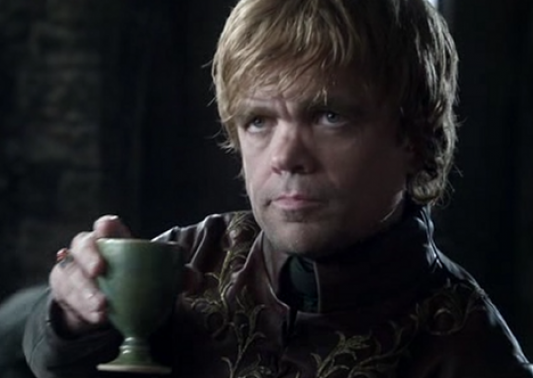
The next set-up scene is back at Winterfell. The characters of the king and members of his family are mostly set up before they are seen, in particular Tyrion Lannister, who is endowed as the boozing, whoring, dwarf brother of the queen who everyone talks about very much like the classic endowment exercise, Here Comes Johnny.


The final big introduction scene, introduces Viserys and Daenerys Targaryen, another twisted sibling relationship.
The brother comes in calling her name and when he finds her adds, "There's our bride-to-be!" The scene is set here. She's about to get married and clearly deadened by the prospect judging by her manner. That he is plotting to gain the throne is made clear a couple of lines later. There's hint of the abusiveness of the relationship but we don't learn that they are sister and brother until the next scene, but we know plenty about of their relationship by then and the fact they are siblings heightens it to disturbing extremes.

So, what can we conclude? I think it's clear that TV shows and movies use many of the same techniques of endowing that we use in improv. Even the blunt ones. People do come into a scene saying "Hey, sister!" etc. And although we might find it a little heavy-handed sometime, the audience doesn't mind as long as it gets the information it needs. And it doesn't have to have it all at the top. We can let it trickle out as we find out other information about the world we are creating. But making something clear as soon as it is established is important whether it's at the start of a 3 minute scene or a 6-season epic.


Monday, 2 June 2014

Improv vs Comedy

Like a lot of people, I got into improvised comedy because I enjoyed being funny. And like a lot of people over time I came to the realisation that comedy is not at the heart of improv, but the genre it is generally played in. In fact, comedy can often be at odds with improvisation.

A lot of comedy comes from breaking things. There is much comedy in destruction. Many a punchline reveals that things are not what they seemed. That's all very fantastic when it’s the end of a joke, but in a scene it can be hard to recover from. The rug has been pulled out from under the scene and you effectively have to start again. Jokes like these are called "gags" in improv – jokes that halt or destroy the action. They don't always seem so bad in shorter scenes, but they can be lethal if you are trying to get an audience to care about what's going on enough to make it last longer than 5 minutes. It is especially damaging when the gag reveals the situation to be sexual, gross, racist, sexist or other things like this. The laws of improv means you need to go down that path once it has been stated, which might have a very negative impact on the engagement of the actors and audience.

Other destructive forms are outright nos. Saying "no" is funny. Any form of spanner in the works can be very funny. Here's a classic example which nearly always results in a one-dimensional scene:

"You are a highly respected doctor with so much experience."
"It's my first day."

I've seen several groups who somehow manage to block so much for humorous effect, every offer seems to be inverted in the manner of the one above. If that's fine with the rest of the group, it can make for a show with lots of laughs. But I argue that these sort of laughs coming from the laughter response to surprise only work on a very shallow level, become predictable quickly and make it very difficult for the group to create something with any depth.

Laughs that come from connecting two seemingly unconnected things, from the characters themselves or from a great reincorporation are much deeper and much more satisfying.

Concentrating on the funny often leaves the relationships and story untended. People going simply for laughs will much quicker go into areas of sex, bodily functions or having a go at whatever racial group is out of vogue at that time.

Actors who concentrate on the funny are often the least supportive of their fellow players who tend to be the ones running around justifying the crazy stuff the one trying to be funny is saying. The problem, of course, is that the player going for the funny is (often) getting laughs, especially from people new to improv, so this is behaviour easily reinforced.

I don’t want to sound like I'm against funny. I'm not. I describe myself as a comedian and love nothing better than getting a room to laugh. But over the years I have, in improv, been trying to shy away from the selfish, destructive laughs and trusting that if we all work on making the scene awesome, there will be moments of humour that arise. In fact with the right group and experience, they'll arrive almost as much as if you block every offer that comes along and they'll be a hell of a lot more satisfying to everyone.

Are you with me?
(It's okay, you can say a big "NO!!!!!" here, that's actually a good out.)

Monday, 28 April 2014

What if there is No Chase?

In my last post, Cutting to the Chase vs. Building to the Chase, I talked about how if you set something up, you should do it. You can delay it, but you have to do it. Now I'm going to tell you that you don't always have to do it. Just to muddy the waters. But to clarify if delaying the action happens for 10% of things set up, not doing them is closer to 0.1%. (Percentages estimated.)

The main tenet to follow is that everything happens for a reason and if it doesn't happen, it doesn't happen for a reason.

Thus if a character says he'll do something and doesn't early on, this clearly establishes him as the sort of person who doesn't keep his promises, is flaky, etc. Or things set up and not done might be a game in itself. I haven't thought of other examples apart from the following...


Sam Super, Ryan Millar and Peter More by Tatjana Todorovic
In the last entry, I mentioned how Shakespeare would love to build up action by having the character torment him or herself over it. I gave the example of Hamlet doing his "To Be" bit. Hamlet in the mentioned scene is contemplating the pros and cons of suicide, which he doesn't go through with. So, that begs the question do we always have to go through with what's set up even if we have made a big fuss about doing it? The answer is no, but you nearly always should. So there is another guideline we can consider...

If you set something up, you don't have to go through with it, as long as you have a compelling reason AND there are consequences of not doing it. 

This is harder to deal with from a conventional improv-training point of view. To not do what is set up. I agree, this should not be the norm. In fact it should not be the first offer that is not fulfilled because that initiates a pattern of not doing what is set up and is like the first example of a flaky character.

In fact for beginners, we should be wary as it is probably an example of the actor wimping, i.e. not wanting to go there. But it is okay on occasion for the character to "wimp" if there are consequences for this character or other characters by the inaction. So the event not happening should, generally, be marked as a point in time where a decision was made NOT to do it. It should come from a strong reason that compels one or more character.

A classic example of a story which includes something like this is Snow White. The huntsman is charged with killing Snow White. In most conventional improv terms, this means Snow White should be killed – we should do the deed and see what happens next. But in the story, the huntsman takes pity on her and lets her free. The pity is a compelling reason. And the consequences? Well, the whole rest of the story hinges on Snow White not being dead, otherwise it would be a story about a wicked queen who simply kills anyone more beautiful than her and then marries a wondering prince. Or maybe the tale of a huntsman who carries out a killing ordered by his mistress, and the effect that has on him.

The compassion shown by the huntsman heightens the cruelty of the queen and the innocence of Snow White. In a Fairy Tale it helps establish her up as the main character. And in terms of a hero's journey, she has undergone a near-death experience and been forced out of her ordinary world, which clearly defines her as the hero at that moment.

This is interesting, because from an 'unstructured' story point of view, the moment Snow White is not killed the story has the chance to fork into three possible broad paths:
  1. It is Snow White's story as the person who has lost the most and thus has the most to gain.
  2. It is the story of the huntsman who has now been shown to be compassionate, but has put himself at risk of displeasing so cruel a queen.
  3. It is the story of the wicked queen and this is almost certainly planting the seeds of her destruction.
 If this story was improvised, I do think it would more likely end up as (3) or (2) than (1) which is what the fairy tale actually is. Partly because these are the order of the strongest, most defined characters.

Not killing Snow White is not blocking as long as it's justified why the huntsman doesn't go through with it. The offer from the queen can be stated, "I want Snow White dead." It is a desire and desires and opinions can be contradicted by other players – they are allowed to have opposing desires and opinions. And as long as the huntsman agrees that the queen wants Snow White dead, agrees that the queen has ordered him to do so and that the queen is powerful and disobeying her is not something one should do lightly, not killing Snow White is "yessing" all that and adding that he himself has compassion and morality. In fact this acts to heighten the evilness and power of the queen. After all the huntsman didn't simply turn to her and say, "no way, José! That's just wrong." He is afraid of her and at least goes through the motions of going through with it. It all proves she rules the kingdom by fear.

Dizzy and the Pit Kittens by Catherine Gray.
As you can see, this can be complex to analyse, but not if you view it in terms of the wants of each of the characters. And at that moment (and for the rest of the story), the queen wants Snow White dead, Snow White wants to live, and the huntsman wants to do his job, but does not want to upset his own conscience. The huntsman, with his dilemma is, in a way, the focus of the story at that moment.

In fact, tragedy can often be seen the hero not doing something he ought to do, or doing something he has been warned not to do, which all leads to his demise. If the huntsman had killed the innocent Snow White after some moments of uncertainty, then this has all the makings of a tragedy whereby the echoes of that killing reverberate throughout the story until the tormented huntsman takes the life of the queen before turning the axe on himself.

So, to summarise...

If you set something up, nearly always do it. However, getting there can take time depending on how important or difficult it is. In rare circumstances, it might not get done as long as the character(s) have a compelling reason and its not happening is significant to the story.

That's enough complications. Please don't think about this during shows, but feel free to use it in the analysis of the stories you end up telling. Or don't use it, if you have a compelling reason not to. ;-)

Sunday, 27 April 2014

Cutting to the Chase vs. Building to the Chase


When teaching improv, we impress on the actors how important it is to follow through with something. If you say you are going to do something, do it. Do it straight away, before you get distracted by other offers and forget it or before you think too much about it and decide it's not good enough. This goes a long way to reinforcing doing what you say immediately as a central tenet of improv, but it isn't. It's just a good way to reinforce good habits.

So perhaps the real tenet is...

If you set something up to be done, you must do it at some point.

Photo by Véronique M
This means it is acceptable to set something up to be done, that doesn't get done immediately, as long as it gets done before the end of the story. How long it takes to get done depends on how important or daunting it is and whether there are steps that need to be done before. Also, sometimes the completion of a particular task will signify the end or beginning of the end of the story, so that's worth holding off from.

A clear example in a lot of shows is some big task that everyone is working towards: the ball, the race, the dance-off, the concert. Something that is important and it's happening will signify the end of the story.

Shakespeare is great at setting up deeds that must be done, and then spending a long time talking about them before they happen. This in improv is discouraged for newbies because this talking about it is usually happening as a way of simply avoiding doing it. In Shakespeare it is done to make the deed seem all the more daunting, and also to learn more about the characters who intend to do it. The scene of weighing up the pros and cons often gives us some of the greatest Shakespearian dialogues and monologues. ("If it were done when 'tis done..." from Macbeth and "To Be or Not To Be" from Hamlet.)

How long you wait to do the thing you set up depends on how important or difficult it is. If you say you are going to clean the car, you are almost certainly better off doing it straight away. If you are going to kill the king, a task which requires a lot of planning, guile and risk, then it's good to really build up that tension and make the act as huge as possible. Compare the anguish Macbeth goes through before killing King Duncan with the following snippet from an improv scene:
Alphabus   "I'm off to kill the king."
Betamus    "Okay."
The king enters. Alphabus stabs the king with a flourish. The king falls to the floor with a face of comedy surprise.
 The above is all very amusing and, boy did it cut to the chase, but in terms of drama and making us care about what's going on, it registers somewhere around zero.

Of course, it's much easier to start with, simply doing everything as and when it's set up. You reduce the risk of an offer being forgotten or lost amongst all the other offers, but that doesn't mean you can't take a moment to soliloquise on risks involved before getting down and doing it.

Photo by Mathieu van den Berk
So, in short, delay in doing something can be good, as long as that delay is to build up tension, importance, etc, or to visit other parts of the story or stories. But it's a real tightrope walk because simply delaying something isn't building tension. And simply saying something's important doesn't make it important, you have to show that it is important for the characters.

And it's good to remember we are talking about only a relatively small number of actions.  Generally, most acts that are set up should be done immediately: Stuff needs to happen throughout the story. A few things might be delayed in their execution and thus become important things. But it's still perfectly possible to have a story without delaying an event.

Perhaps it can be best put by paraphrasing the old impro saying, when you encounter the door with the monster behind it, you should open that door, but the door with the scariest monster can be saved until last.

Saturday, 19 April 2014

Reincorporation example #1: One, Two, Three (1961)

So, been playing with video and sound and decided to make some illustrations of comedy concepts. These are not only useful for improvisers, but for stand-ups and all sorts of writers. Reincororation is not just for comedy, in fact it's a big part of storytelling. If nothing comes back, you don't have a story. Love to know your thoughts.

Friday, 18 April 2014

Ceci n'est pas un tour.

This blog is mostly my overly analytical thoughts on improv and occasionally opinions on shows I saw or workshops I took. Lately I've been doing a lot more travelling with improv and this side often doesn't get documented because they tend to be very busy times.

I've just spent the weekend in Brussels, the home of Eurocracy and a vibrant English-language performing scene. Certainly, theatre-wise, Brussels seems well served, and improv-wise, there is a growing scene with a couple of overlapping groups at the centre of it.

The first day was a typically, busy international travel day.

It started so early that the mist the Earth sprays over herself to keep from wrinkling was still there. It feels rude to move about the Earth before she's fully awake. The train I got on rolled out of Amsterdam and into the misty Dutch countryside at 7:13. Four trains later (it is usual to do it in less), we were in Brussels.

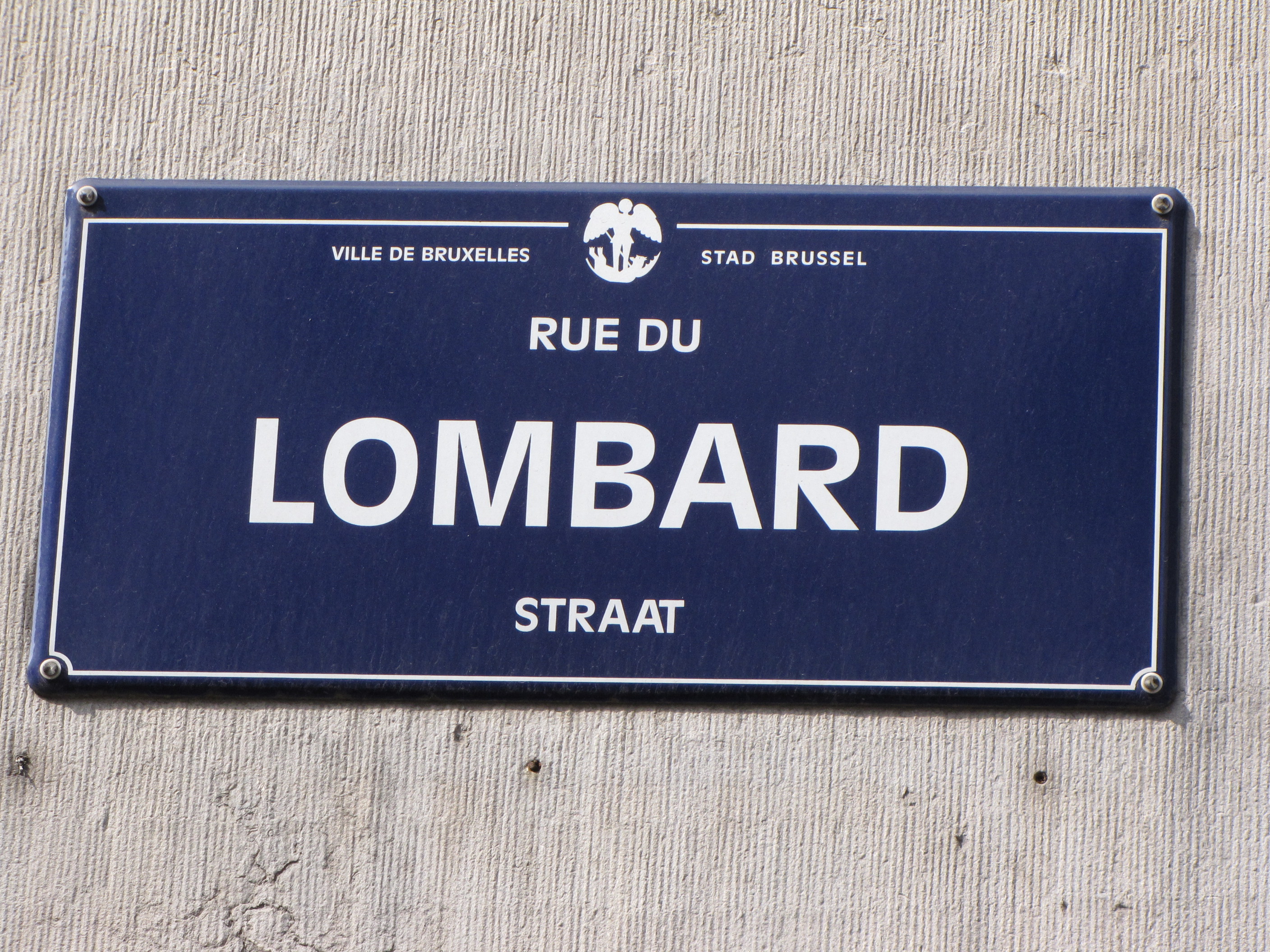
The fun thing about Brussels is that it is a bilingual city. French and Flemmish are the two tongues that dwell there. Flemmish is like Dutch but ironically using a lot less phlegm. Streets, buildings and maybe even people in Brussels have 2 names. Street signs often have a clever way of showing the name highlighting the common part that is the most important.


But there are also streets where the name is not so similar in both languages. A clear example that highlights some of the main differences in the languages, is Boulevard de l'Emperor or Keizerslaan.

Important buildings also have two names. And although people tend to be quite strongly divided by the language they speak, I do wonder if there are are some people who embrace the two-language nature of the land and have two names. eg: Jorgen van den Berg / Georges de la Montagne.

On the train with me was Sacha Hoedemaker, a terrific musical improviser and we were going so early because we had to teach workshops. Sacha on the art of musical improvising and me on movie and TV genres. This is one of my favourite workshops, where we get to grips with the genres the group is interested in or finds particularly difficult. It's a particular favourite because my knowledge of genres, through years of watching and over-analysing films and TV shows is (as the Belgians would put it) encyclopédique / nerdelijk.

After dinner, it was show-time. I was there with Dizzy and the Pit Kittens, a group formed during one of those gatherings in a bar where four people all realised they'd like to work with each other. We started out exploring allowing scenes to be absurd or abstract. Our original format, Whirlpool, allows scenes to be either of these or also realistic or at least rooted in the real world.

Abstract in improv, we found, often means that rather than accepting physical offers verbally by justifying them and tying them to a real-world activity or by the improv cliché of "oh, yes, you are doing that because..." you justify them by allowing them to be everyday actions of the characters. No matter how ridiculous. We don't explain why the characters are wriggling their arms in the air, we do whatever is necessary to ensure that it seems normal.

Dizzy and the Pit Kittens were in Brussels as guests of The Ghost Sheep, an English-language group, hence only having one name. They are not Les Moutons Fantômes / De Spookschapen. They haven't been together as a group for very long, but they perform quite regularly and are very good at attracting foreign guests to perform and teach, along with other local schemes such as Improv Barter.

They have a couple of theatres they use and seem very good at striking deals with them and other organisations. They are fun and supportive players who seem like a group that's been together much longer than they have.

For the show, some of my workshoppers showed off some of what they'd learned (in which they did a great job), and then The Ghost Sheep showed off what they'd learned, by performing a great mini improvised musical.

In the second half, Dizzy and the Pit Kittens did their thing. As well as the allowing scenes to be absurd or abstract if they want to be, we have a couple of other conventions. We dance at the beginning to give ourselves starting positions, never leave the stage to allow scenes to flow easily and end with a short recap. Music is quite important to the format and so we made sure we had a great musician with us.

Of course there are people out there who can go straight off to sleep just after a show. Those people don't count me in their number. So, in all, it was a long exhausting day. Fortunately the next one was more restful for me. Other Pit Kittens had to teach, I could lie in and then wander around town.

I've been to Brussels a couple of times before so I've seen the Grote Maarkt / Grand Place and Manneken Pis / Le Petit Julien and the other key things Brussels encourages tourists to see. So my plan was mostly to wonder around bits I hadn't seen, but it wasn't long before I bumped into a small gang of museums. I like museums, but I don't go as often as I like / should. I hadn't planned to go to a museum, but one of the gang members was a Magritte museum. I'm a big fan of René Magritte, or rather, I'd loved a few of the pictures I'd seen by him but knew nothing much about him. In fact I'd assumed he was French, but turns out he was Belgian. So if you like an artist and fate blocks your path with a museum about the him, I'm not sure there is any sort of decision to be made here. Fate says do, you should do.

The museum was, as museums tend to be because that's what they intend to be, educational. What I found very interesting was seeing the things Magritte was obsessed with at different stages. The objects, the ideas, the people. He seemed someone who was overly analytical at times, which is no bad thing, I reassure myself. I quite understood his quest to find the connection between objects, the depiction of those objects and the words which represent those objects. I love his playing with and subverting visual expectations and notions of realism, such as covering a the subject's face with an apple and having a night-time scene have a daytime sky.

What also fascinated me were how often he would repaint the same picture, with the same elements, but arranged differently, or framed differently and maybe even given a different title. It is also interesting to see how objects that recur in multiple pictures, such as a sphere cut in half, creates something that is not lacking imagination, but somehow fascinating. Like there is a bigger story outside the pictures.


There were a couple of key well-known pictures that didn't seem to be in the collection which was a little disappointing, but if you compare with what was there, it's a minor quibble. One of my favourite things on display were some small sheets of paper depicting strange alien forms entitled Cadaver Exquis. These were created each by 4 artists from one collective - René Magritte, Louis Scutenaire, Irène Hamoir and Paul Nougé - by playing the game many of us have played as children and adults, where a piece of paper is folded and each person draws different segments of the body without being able to see what the others have done. I was so happy that even world-respected artists can still engage in such playfulness and collaboration.


After dinner, there was another show. It started with a demonstration of the dance moves learned by Laura's class and then Dizzy and the Pit Kittens premièred their new format, Octopussy. It's very different to the Whirlpool format being completely about relationships and set very much in the real world. It sees eight characters who are all linked and then brings them all back for a big finale.

The second half was Dizzy and the Pit Kittens joining up with their good friends Les Moutons Fantômes for a good old Superscene, a format where 3 movie directors show you the start of their latest movie and the audience decides who gets to make the next part, with only one getting the chance to finish it.

It was sad to go home. It was good to practice my French, although often I would end up speaking a curious mixture of French and Dutch, but somehow that seemed right.

One day I will tell you why I think Brussels Zuid-Midi station is not really a station but a haunted office block in which the ghosts contrive to make you think it's a station. But that's for the next time. For now I can only once again say a huge "Thank you" everybody involved, in particular the organisers and our hosts, for making the weekend such a great trip and allowing us to get involved in their great scene.