Thursday, 25 January 2018

IMPRO Amsterdam 2018 - Opening night

Festivals should begin with a bang. That is unless you running The International Festival of Slow Fades, or Disappointed! The Festival for Mismanaged Expectations. (Both of which are great festivals, but I’ll discuss them another time I absolutely promise. Honest.) But this festival went for the tradition of bangular openings.

This show is the first chance for the general public to really see the ensemble cast. For this first show, everyone performed in their original teams. Each team has a show of their own later in the week. Except the Dutch who were only assembled as a team for this festival and are merely along for the ride. It's a kind of taster for the whole week.

(Also there is another team with a main-stage show that is not part of the ensemble, but I won’t mention that now to keep from confusing you. It’s Dad’s Garage.)

Each team showed off a bit of their style and were then given a second challenge to pay homage to another team, which got Americans being Australians, Australians being Dutch and the Dutch rapping. What could possibly go wrong?

Ouestern!

The second half of the show was given over to Project2 an English duo who improvise in the style of science fiction. It is fair to say they kicked the ball straight out of the stratosphere. A lot of improvised science fiction is goofy, soulless, gadget-obsessed parody. (Actually a fair few movies are too.) Katie and Chris (who are the current incarnation of Project2) are doing this out of love and respect. They know their science fiction. They might mock it, but they do it with love. They can find the funny, but they are not afraid to be truthful and their commitment cannot be questioned. The stories they weave and eventually manage to tie together contain so much human truth, that the end was a veritable burst of joy.

And all this with a superbly atmospheric live soundtrack by one half of noughties electronica duo Lemon Jelly.
Zombie vs Sentry Drone

Night at the Museum of Stories
After most of the shows this week, there is a choice of 2 late night shows. Firstly, there were Brazilian living statues with Museum of Stories. Yes those actual living statues you find in most big cities on the streets near the most touristy of spots were brought into theatres to be both statues and actors in scenes. Any improviser who has ever had to try and be still on stage for more than 1 minute can learn a lot from these guys.

And secondly there was some “playback theatre” from local group, Wordt Vervolgd (which means To Be Continued). Playback theatre is where the audience tells their stories and these are then recreated or interpreted on stage for fun or therapy.

In all a great official first night. Well up there with the opening night of Bangfest IV: The Bangening.


Tuesday, 23 January 2018

IMPRO Amsterdam 2018 - Secret Preshow

A festival the size of IMPRO Amsterdam doesn’t just happen because of the efforts of one person. There are scores of people who help make the magic happen. From the artistic team who decide which teams come to the people who wash the dishes after the performers have eaten. (Yes, this festival provides food for the performers. I know, right!)

As many of these volunteers as can fit in the chosen venue (about 50) are rewarded with an extra free show where they get to see the newly assembled team show what they can do. It’s a very nice pre-actual festival show. A time to really play with your new friends but without the pressure of a show in a 220-seater theatre.

And house spirit makes three.
The players were divided into two groups, spreading each of the national teams as evenly as possible between them. Each group played for 40 or so minutes. Showing off the mixed skills, styles, heights and accents of the cast. It’s hard to remember scenes in shows you were in, but from what I recall there were scenes about how accommodating French hairdressers can be to uncomprehending foreigners; haunted hotels where you can probably never leave; the difficulty of finding pets that will stick around; waiters caught between a hard chef and a gang of customers; the complexities and absurdities of negotiating a shoe shine; and the importance of light-switch positioning when taunting light-fearing demons. All very valuable lessons in life.

You actually can'r even check out anytime you want.
There was definitely a lot of not just playing well together but the joy of playing together on display. It all ended with a huge dance number including much of the audience, which, being almost entirely made up of improvisers, was more than will to join in.

It’s already uberfun and it’s not officially started.

Megajazzhands

Sunday, 21 January 2018

IMPRO Amsterdam 2018 - The cast meet the cast

Drawing the teams from 5 countries (over 3 continents), the men and women behind the organisation of the festival have pulled together an awesome, diverse team of players. There are Hip Hoppers from New York, Science Fictioneers from London, Comédiens physiques de Strasbourg and a couple of talented sheilas out of Melbourne.

These, with 6 Dutch (and adoptive Dutch) players, form the main stage cast for this year’s festival. There are other players doing the more specialised late-night shows and adding to the number of countries and continents, but I’ll talk more about these later.

Some of these people had met before, but many had not. They arrived as several different-shaped containers of talent, and the first stages of mixing them together and making them a team began Saturday, with a dinner and a chance to play together.

Dutch bikes after the storm.
“Familiarity breeds content” is an old adage in improv that I just invented. And so this was a chance for the players to get to know each other, both as players and as people. The more you know and like someone, generally, the better you perform together. It’s true. Try performing with someone you just met who you hate. It’s really difficult. Everything they say is so stupid.

After the foundations of the team were built, the next, more powerful method of bringing people together took place. Dinner! Food unites people. The communal breaking of bread (or, in this case, pizza base), is guaranteed to bring people closer together. Unless for some reason they like Brussels sprouts, in which case everything they eat is so stupid.

Also, there was alcohol. Everything that goes for food, goes for alcohol (except the effects are quicker but much shorter lasting).

After all of this there was a chance to perform for each other and see some of the skills these kids have brought to town. Oh, man, are you in for a great festival!

Saturday, 20 January 2018

IMPRO Amsterdam 2018 - introduction (not that it needs one)

In September last year, Theatersportvereningenamsterdam (TVA), organised a kind of knock-out competition to find who is the team to represent the Netherlands in this year’s IMPRO Amsterdam. The various gods of comedy smiled on me that night and I am to be part of the 6-strong cast of funny people who next week will, as they say, represent.

For those of you who don’t know IMPRO Amsterdam, shame on you. But, it doesn’t matter, it will happen without you knowing about it. And even if you know nothing about it, it doesn’t really need an introduction, all you need to know about it is in the title. And certainly if you use it’s full title, “Improvised Comedy Festival Amsterdam The Netherlands 2018.” (Which in Dutch would be “Improvisatiekomedietheaterfestivalamsterdamnederlandtweeduizendachttien” (IKTFANTTA).)

As last year, I intend to blog every day about the festival. This time from an insider’s perspective. As a performer at the festival. I’ll give my impression of the highlights, the lowlights, and the midlights. I’ll give you the low down, the goss, and the words from the streets. I give you as much as I can before I fall asleep through sheer exhaustion, because it’s quite a full-on week.

So, if you can’t make the festival, keep reading and live it through these words and occasional pictures. If you can make the festival, still keep reading and see if you agree with my twisted view of what happened. And if you are involved in making the festival happen, keep reading as all this is dedicated to you.
The Dutch cast: Jochem, Sven, Nardje, Huib, Nicole, and
Myself (winning the goofiest expression competition).

Monday, 4 December 2017

Personal Boundaries And The Stage


You are on stage in the middle of a scene. The other player is someone you have seen around but have not played with much before. The scene started fine, but somehow it seems to be going out of control and suddenly your scene partner is up very close and grabbing you. You feel uncomfortable but put it down to being inexperienced or that you missed something. After the show, rehearsal or workshop is over the incident sticks with you longer than you expect. Does this sound at all familiar to you?

An essential thing that is missing here is not experience; it is trust. A comparable interaction with an improviser you have played with a lot maybe does not bother you. The trust is there; you are looking out for each other.

In improv we spend a lot of time out of our comfort zone. So much so, that we can find it difficult to realise straight away when things go too far. It can be hard to differentiate between the discomfort of being on stage with no idea where the scene is going and the discomfort of doing things that are crossing personal boundaries for you.

For some things, the best illustrations come from workplace stock photos.
There is a difference. On a low level, it feels different. But it may get mixed in or confused by the higher part of your brain with everything else that is going on.

Things that cross personal boundaries are varied. They are things like physical closeness, bodily contact, especially if not gentle, and things that are more intimate. It can also be of being in a scene where the content is uncomfortable somehow. Mostly I’ll be talking about physical contact as this is where the greyest area is. I’m not even talking about when it is actually violent, dangerous or genuinely sexual as this is never okay.

We all have boundaries about these sort of things. They vary for different people; they vary by situation; they vary depending on who else is in the scene, who is in the audience, and what has happened that day. And it’s made harder because when you begin, most of improv is putting yourself out of your comfort zone.

But these boundaries exist and they should be respected. By yourself as well as others.

As I said, we tend to blame ourselves that we aren’t better improvisers or that we didn’t understand what was going on. And worse, scene partners can also often blame us if we don’t fully go along with where they thought the scene was heading.

A very clear example of what I’m talking about is being handled roughly in a scene, say grabbed forcefully. This will almost certainly cross a boundary in the other player if you don’t know each other so well and haven’t discussed this sort of thing.

Sometimes, players do realise their boundaries are being crossed on stage and their response is influenced by that. But even here, there is a tendency for the performer to criticise themselves for their response and even for the other player to do so too.

This scene has been recreated by actors.
Let’s take as a specific example, Augustine has gone to touch Bertha’s hair and Bertha, not feeling comfortable with this, has leant back to avoid the touch.

A frequent response to this is afterwards for Augustine to complain that Bertha blocked him. Which is not true. You can say that Bertha yes-anded their own sensibilities (boundaries), and, indeed, that of the audience, who would not want to see a player truly uncomfortable.

Now, was Bertha overriding Augustine’s offer with her own internal impulse? I say no. The impulse was a reaction to the offer.

Yes, in  a different situation, if Bertha trusted Augustine more, she would have possibly allowed him to touch her hair. But this is irrelevant. What matters is what happens in the scene between these players at this moment.

The problem here is not Bertha’s reaction to the offer, but Augustine’s response to Bertha’s reaction. If Augustine was paying full attention to Bertha, he should have realised Bertha’s response was due to boundaries being crossed. He could even have seen the signs before hemade the move and made a different offer that indicates the same emotion but less intrusively. Bertha’s response is an offer, and as it was so nicely put to me recently: “Your job as an improviser is to make your scene partner comfortable. If they feel uncomfortable or scared, you have failed.”

Augustine’s objection comes in part from only seeing his offer as he originally intended it. He is seeing his offer as “A touches B’s hair,” but this is presumptive. The offer is in fact, “A tries to touch B’s hair” and the response is “B avoids the their hair being touched.” In terms of wants of the character, there is no blocking. In fact it’s fine for two characters to want different things as long as they acknowledge the others want.

The real problem, of course, is the fact Augustine reached for the hair at all when Bertha wasn’t ready for it. It shows there isn’t a good connection between the scene partners and/or the offer to touch the hair really wasn’t the next step in a process of discovery by the two players in that a scene. In fact, in most cases this sort of thing happens because one actor is railroading the scene, pushing forward their own vision of what should happen whilst taking little input from the other player.

I’ve heard people explain that they went too far because they were “in the moment.” But “the moment” is not just whats going on in your head, it’s what is happening all around you, between you and your partner. Being so into something you are doing that you don’t notice your partner is NOT improvising.

Improv is about taking care of each other. It’s about paying attention. Inattentiveness is not an excuse. We have to be attentive: it is the CORE of what we do. If you are not paying attention how can you accept?

Being aware; Read signals; Always be respectful.

And this doesn’t just happen between actors who don’t know each other, it can happen between people in the same team, people who have played a lot together. As we said, it’s not about inexperience, it’s about not paying attention

If you do accidentally go too far, which can of course happen, you should be aware of it and adjust. Use the response from the other player in an accepting way, and most of all apologise after the scene. You might step over a line very occasionally, but have the awareness to realise it and the humility to apologise for it. The big problem is not that it happens at all, it’s when it happens frequently.

If you find yourself in the situation of being uncomfortable due to boundaries being crossed, don’t be afraid to let your scene partner know. Any good, attentive improviser should pick up on this and use your response as an offer and certainly they should not push further.

You are not being a bad improviser for not accepting something you feel highly uncomfortable with (i.e. something beyond any normal feeling of being out of your comfort zone in improv). As I have explained, this is usually not actually blocking.

What can you do if your signals are not seen?
  • You can make them more obvious.
  • Make an offer that deflects where the scene is going. 
  • You can even call out the actor’s behaviour attributing it to the character.
  • And if still, it continues, you can always leave the stage. No show is worth being made to feel unsafe for. Your integrity as a player is more important than the scene.
(These are easier said than done, I know, but it’s good to be aware of options.)

Players on the side can also help.
  • Edit the scene and start a new one or tag one of the players out.
  • Intervene as another character or voiceover.
  • Bring it up after the show/rehearsal.
The audience will probably have sensed your unease and will not want it to carry on as it is. In fact, in cases like these, often only one person wants the scene to go the way it is going, and that’s the player forcing the offers.

This sort of thing affects us all, whether you are a victim or not. In fact, I’m sure more people have had this happen than you think. Maybe all of us. Not too long ago, I was groped on stage by an actor I did not trust who did it because he knew I would accept it and because he thought it was funny. (The audience did laugh, but mostly at the how weird and inappropriate it was.)

Discussing this sort of thing within you group, saying what people do and don’t feel comfortable with is the best way to raise awareness and prevent things going too far.

Everyone, especially more advanced players, should be more attentive to this sort of thing (and not just on stage). We should edit uncomfortable scenes, call-out inappropriate behaviour, remind everyone that this is a medium that only works when we work together. As always we should remember the words of the great guru, Gerald Springer, “Take care of yourself and each other.”

Saturday, 2 September 2017

Ten lessons for improvisers from the movie Alien

Alien (1979, dir: Ridley Scott) is a great example of a science fiction movie. You may have seen it. Frankly you should have seen it. I don’t think you need to have to follow this post, but why resist seeing it, you’re only depriving yourself.

Improvising in science fiction is fraught with danger. These dangers are the same that film-makers also face. So looking at a successful science fiction movie can give us some insight into how to do it well. The same goes for horror, which is relevant, as we will see. Let’s look at Alien and find ten lessons about improvised genres and improvised narratives.

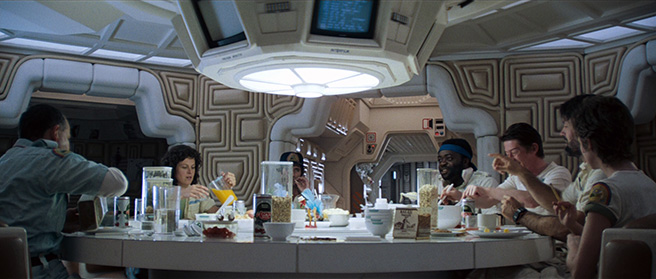
People still eat, no matter what era it is.
  1. People have always been, and always will be, people. People in science fiction don’t have to be weird, unrelatable aliens. In fact they rarely are. The crew of the Nostromo are blue-collar workers doing a hard job. They are the crew of a towing vessel. Today they would be the crew of a freighter. They are all people we could and relate to in our ordinary non-future lives. 
  2. Establishing character through dialogue. Our main introduction to the crew is through a conversation over a meal. Here they chat, joke, argue and generally show their outlook on life through how they talk and what they say. Again, it should be noted, they are not talking about weird space stuff, they are talking about getting paid and what their job entails, and the sorts of things we talk about when we’re at work. People will not be radically different in a few hundred years time.
  3. Science Fiction often has another genre. Although most people would say the genre of the movie Alien is science fiction, the story is pure horror. Science fiction is almost always a filter put over the top of another genre. At least, that’s how I like to view it. Science fiction is actually very broad as a genre, and in a way gives us very little concrete to start with, and plot-wise gives us even less. A science fiction story can be set in any time or place, both real and imaginary. It doesn’t have to be set anywhere near space. However, if a story is set in space, it is automatically science fiction. (At least it will be until space travel is boringly routine for us as a species.) Alien goes for what could be called a classic setting for science fiction, a space ship. But it is not an exploration ship on a voyage to explore new planets; it’s not a battle cruiser off to battle against the interplanetary federation; no it’s basically a tug taking a cargo of something mundane back to Earth.

  4. Relationships. It’s important to establish the relationships of the main characters early on in a story. A lesson here is that, most relationships are not going into in much depth. This is not a relationship-driven story and in fact not so much time is spent on it, but you do get to learn some of the connections that people have to each other – it’s mostly who gets on with whom and who doesn’t get on so well together. This is partly because there are 7 characters at the start and so we can’t keep track of 21 relationships. (The equation is n(n-1)/2, if you were wondering.) It’s also because horror is not (usually) a relationship-driven genre. The action is not dictated as much by the actions of the main characters as it is by some outside entity. Plus most of the people you meet at the beginning ain’t going to make it. In horror, as a rule, we don’t follow and identify with the main characters because we are fully invested in their character but because we empathise with their predicament and don’t want them to be brutally murdered.
  5. Alien is not about the alien, but about the crew’s attempts to avoid getting killed by the alien.
  6. Baby killer aliens can be cute too.
  7. Gore or lack of it. Although we see some of it, we don’t actually see too much of the alien killing the victims. Horror (aside from the gore and slasher subgenres) is much more about the build-up of suspense and the reactions than the actual horrific acts. Which is good for improvisers as it’s hard to mime a good decapitation. Especially one that isn’t funny. But atmosphere and reaction we can do. However, the trick is that atmosphere and reaction require total commitment to it. Which sounds like the realm of improv, but, in improv the commitment is often only to the funny, and applied far less to the dramatic or real side of things. But with commitment (and good music) a scary atmosphere can be achieved pretty easily. One good tip is your character should genuinely be scared. At no point in the movie do you think, “that actor is just playing scared.” You certainly don’t see what you too often see on an improv stage, a character playing some sort of vaudevillian, knowing spoof of a scared person. You see the fear of the characters. That’s the only way horror works.
  8. Establish the rules of the world. Some sci fis have wildly different rules to the world we know, but most don’t. The one’s we relate to most do not have that much which makes it alien to what we know. There should probably be some new rules, as this is an important part of sci fi, but there do not have to be many. And the characters are usually used to the rules of this world, and so live them, understand them and are not surprised by them. Rules can be small or large. Things that are different have to be explained or demonstrated. In Alien it is explained that they have to respond to the SOS beacon because that’s one of the rules AND that their pay depends on it. Also, the rules of the autodestruct system (in particular that there is a time-limit to the over-ride function, which only makes sense plot-wise) are explained by the autodestruct’s own voiceover. Also in Alien it is enough to show that steam coming out of vents at various points of the ship is a regular thing for us to accept it is an important part of the workings of the ship, even if part of us doesn’t get why, once we see it a couple of times, we accept it as something that happens in the world of that ship.
  9. Technology changes the way we do some things but we are still humans. We won’t spend all of our time talking about technology (okay, some of us will, but most of us won’t), but we will use that technology in our everyday lives. This is easier to do in a movie where we can show so much without having to talk about it, but even in stage-bound improvisation, we can have scenes where we have a lot of new technology around us, but we just use it rather than talk about it or over explain it. Note this last thing is not just a trap for improvisation, but a lot of terrible sci fi does it too. The trick is to talk about what’s going on with the characters and not about the tools you are using.
  10. Androids and robots are only really interesting when they have or want human emotions. The biomechanical android is so convincing as a human, it only becomes clear it’s an android when it’s head gets knocked off. And although looking back, the seemingly emotional choices of the android had a less emotional driver, it does reveal some emotions we can (sort of) relate to in that it has the capacity to admire. Although it admires the alien for being “unclouded by conscience, remorse, or delusions of morality.”
  11. In horror (certainly since the seventies), just when you think it’s over, it isn’t.

  12. Attitude.

    Any other lessons you’ve seen from this movie? Any alternative takes you have? That’s what the comments are for.

Sunday, 5 February 2017

IMPRO Amsterdam 2017: Final Day

Saturday, the final day of the festival. It’s been a long road, but here is the blast at the end. The final day doesn’t include a group doing their speciality thing, which is what excites me most about this (and other) festivals. It does, however, have two shows where a cast of great people who have been performing, rehearsing and eating/drinking together for a week put on 2 high-impact shows. Plus there’s a party. Partying at the end of a festival likes this seems mandatory. Whether you are a performer who's had a hectic but rewarding week in a foreign land, and organiser who has blooded, sweated and teared to make it all happen to what appears seamless to any one outside of the organising circle, a fan who’s seen a few good shows in a week, or a battle-weary reporter, hoping to get the improv equivalent of a pulitzer. (It’s just as prestigious, but it’s imaginary, which is just as well as so is my mantelpiece* is imaginary. (* - I realise this is an uncommon word, so here is is translated for the visiting groups: schoorsteenmantel, manto de chimenea, Cornija de lareira, spiselkransen, mantel, and, um, imagine putting a shelf above the barbeque.)


The first half of the show was a Western directed by Patti Stiles. It had a lot of dramatic tension, a set and costumes which I am always excited about in improv because 95% of improv shows, you have zero props and no specialist clothing except a checked (plaid) shirt, which or some reason is compulsory improv-wear in many parts of the world. It’s a genre that to do well requires more acting than improvisers usually get to use, but they managed to build some great moments / scenes, both comic and dramatic. And the costumes and music helped a ton. Again Felipe’s character, a wronged man who get’s his revenge, stood out and he gave Laura’s character the rare improv gift of a protracted non-comic death. It was a very Western moment.


At the complete other end of the emotional spectrum, the second half was a High School Musical. Teenagers come to terms with life, love and becoming adults; and sing about it whenever possible. It was a lot of fun (one could say gleeful), and the Swedes, who brought the format and perform this a lot, really shone. Plot- and end-wise there was a bit of confusion, mostly due to having a bit too large of a cast, but the big production numbers benefitted from having those numbers, providing large dancing ensembles (as these things often do). And, of course, it would not have not been anything without the 3 highly talented musicians who composed and played the music on the spot. If you are going to close a festival (and they all have to at some point), you can’t do it with more energy than a musical - old Chinese proverb.


So that was the festival. If you went, I hope you recognised it and brought back fond memories, and if you didn’t, I hope it gave you the impulse to go next year. As ever the quality of the performers invited is top notch and I hope to see more of them all elsewhere.

 Mantelpeace out!